
Constructing Three Concurrent Line Segments via Triangle Centers
Loading the math board and drawing, please wait…
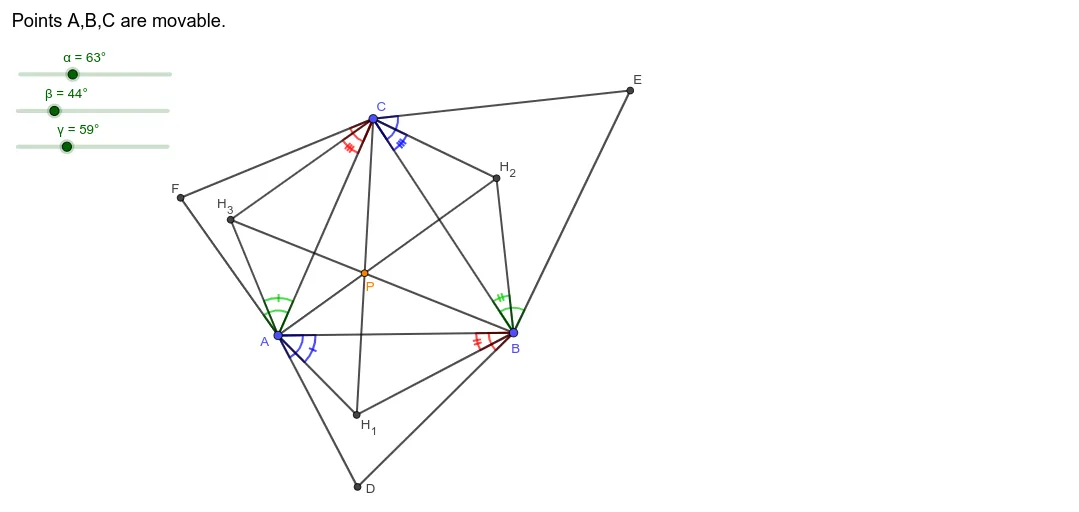
This example demonstrates how to construct three concurrent (meeting at one point) line-segment configurations inside triangle-related geometry. By using rotation-based correspondences and intersection constraints, it builds segments whose extended lines share a common point, while triangle centers organize the structure. Key concepts include concurrent lines, angle measurement, ray construction, geometric transformations (rotation), and locating triangle center points (e.g., orthocenter-type centers). The construction uses Polygon to form the base triangle/figures, Rotate to generate rotated images and corresponding points/segments, Angle and Ray to define the controlling angles and rays, Intersect to compute key intersection points that enforce concurrency, TriangleCenter to place relevant triangle centers such as H_1, H_2, and H_3, and Segment to output the final line segments. Suitable for middle to high school enrichment, competitive geometry lessons, and learners exploring transformation geometry with triangle center properties.
GeoGebra Commands & Parameters
Polygon(A, B, C) → t1, c, a, bRotate(B, α, C) → B'Angle(B, C, B') → δRotate(A, (-β), C) → A'Angle(A', C, A) → εRay(C, B') → fRay(C, A') → gRotate(C, γ, A) → C'Angle(C, A, C') → ζRotate(B, (-α), A) → B'_{1}Angle(B'_{1}, A, B) → ηRay(A, C') → hRay(A, B'_{1}) → iRotate(A, β, B) → A'_{1}Angle(A, B, A'_{1}) → θRotate(C, (-γ), B) → C'_{1}Angle(C'_{1}, B, C) → ιRay(B, A'_{1}) → jRay(B, C'_{1}) → kIntersect(h, g) → FIntersect(i, j) → DIntersect(f, k) → ETriangleCenter(A, B, D, d) → H_1TriangleCenter(B, C, E, d) → H_2TriangleCenter(C, F, A, d) → H_3Segment(B, H_2) → g_1Segment(H_2, C) → h_1Segment(C, H_3) → i_1Segment(H_3, A) → j_1Segment(A, H_1) → k_1Segment(H_1, B) → l_1Segment(C, F) → lSegment(A, F) → mSegment(C, E) → nSegment(E, B) → pSegment(B, D) → qSegment(D, A) → rSegment(A, H_2) → sSegment(C, H_1) → tSegment(H_3, B) → eIntersect(s, t) → PAngle(H_1, A, B) → κAngle(C, A, H_3) → λAngle(A, B, H_1) → μAngle(H_2, B, C) → νAngle(B, C, H_2) → ξAngle(H_3, C, A) → ο
AI Drawing Prompt Reference
Draw a triangle with three vertices. From each vertex, construct two rays rotated by specific angles relative to the adjacent sidescars. These rays intersect pairwise to form three points, each lying near a side extension. Using these intersection points and the original vertices, determine three special center points, each associated with a pair of vertices and an intersection. Connect each center to the adjacent vertices or intersection points with line segments, creating three main segments that all meet at a single common point. Additionally, draw segments from the original vertices to the intersection points and from the centers to other vertices, forming a network where all key lines converge at one point, demonstrating concurrency.
The prompt above was compiled from the original drawing commands and is for reference only.