
Five Orthocenters on One Circle: A Construction Check
Loading the math board and drawing, please wait…
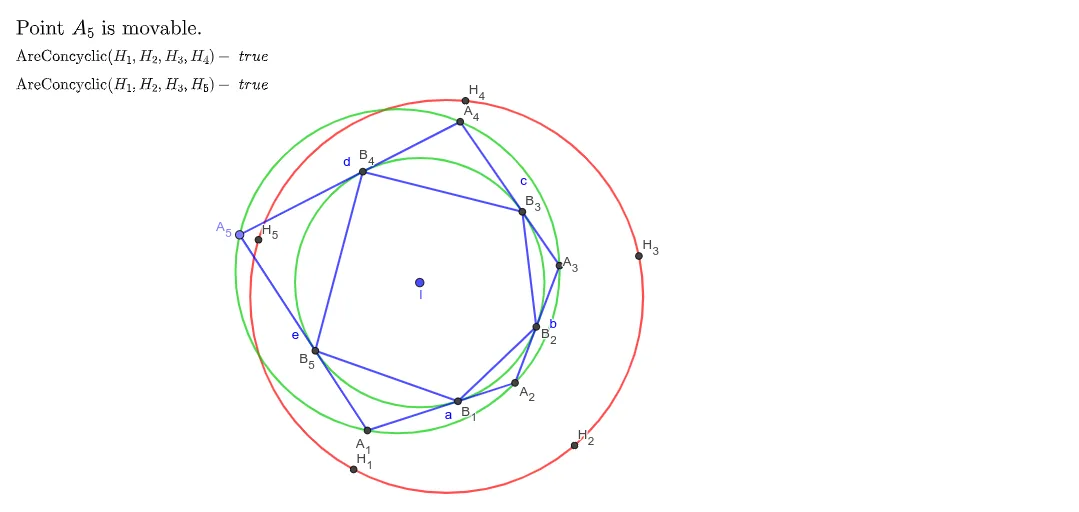
This example demonstrates the surprising geometry fact that five orthocenters of appropriately related triangles all lie on a single circle. The key mathematics includes orthocenters (via TriangleCenter), circles and concyclicity testing (AreConcyclic), and a construction workflow using tangents and intersections to generate the needed auxiliary points. In GeoGebra, Point and Circle create the initial geometric entities; Tangent and Intersect are used to obtain intersection points that drive the configuration; Triangle and Polygon help assemble the related triangles; multiple orthocenters H_i are generated automatically with TriangleCenter; finally, AreConcyclic confirms that those orthocenters are concyclic. Suitable for secondary-level advanced geometry instruction, competition training, and for students learning orthocenter properties, circle constraints, and geometric construction methods.
GeoGebra Commands & Parameters
Point(Circle[I, 0.6]) → B_{6}Circle(B_{6}, 3.899865403266867) → d_{6}Point(d_{6}) → A_{5}Circle(I, 3) → c_{2}Tangent(A_{5}, c_{2}) → g, hIntersect(d_{6}, g, 2) → A_{1}Intersect(d_{6}, h, 2) → A_{4}Tangent(A_{4}, c_{2}) → i, jIntersect(d_{6}, j, 2) → A_{3}Tangent(A_{3}, c_{2}) → k, lIntersect(d_{6}, l, 2) → A_{2}Polygon(A_{1}, A_{2}, A_{3}, A_{4}, A_{5}) → poly1, a, b, c, d, eSegment(I, B_{6}) → fTangent(A_{2}, c_{2}) → m, nIntersect(c_{2}, d) → B_4,Intersect(c_{2}, a) → B_1,Intersect(c_{2}, b) → B_2,Intersect(c_{2}, c) → B_3,Intersect(c_{2}, e) → B_5,Polygon(B_5, B_1, B_2, B_3, B_4) → poly2, b_5, b_1, b_2, b_3, b_4TriangleCenter(B_5, A_{1}, B_1, 4) → H_1TriangleCenter(B_1, A_{2}, B_2, 4) → H_2TriangleCenter(B_2, A_{3}, B_3, 4) → H_3TriangleCenter(B_3, A_{4}, B_4, 4) → H_4TriangleCenter(B_4, A_{5}, B_5, 4) → H_5Circle(H_1, H_2, H_3) → pCircle(A_{1}, A_{2}, A_{3}) → qAreConcyclic(H_1, H_2, H_3, H_4) → oAreConcyclic(H_1, H_2, H_3, H_5) → r
AI Drawing Prompt Reference
Draw a circle and create five points on it. For each point, draw a smaller circle centered at that point. Connect one point to the center of the circle, then from the line connecting the point and the center, cut off equal segments to form five triangles. Calculate the orthocenter of each triangle and verify if these five orthocenters lie on a single circle.
The prompt above was compiled from the original drawing commands and is for reference only.