
Constructing an Equilateral Triangle by chris cambré
Loading the math board and drawing, please wait…
In collections
barycentric coordinates
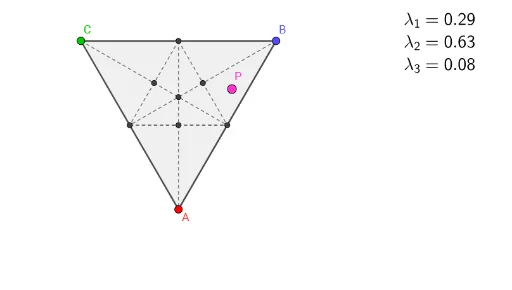
This example demonstrates the geometric construction of an equilateral triangle. It involves core mathematical concepts such as geometric construction, coordinate geometry, and transformation. Key GeoGebra commands and objects used include Rotate, Segment, Line, Polygon, Midpoint, and Intersect. Suitable for high school mathematics teaching and learning.
GeoGebra Commands & Parameters
Rotate(B, 60°) → CSegment(C, A) → fSegment(A, B) → gSegment(B, C) → hLine(A, B) → iLine(A, C) → jLine(B, C) → kPolygon(A, B, C) → driehoek1, c, a, bMidpoint(A, C) → DMidpoint(A, B) → EMidpoint(C, B) → FSegment(C, E) → lSegment(B, D) → mSegment(F, A) → nIntersect(l, m) → GSegment(F, D) → pSegment(D, E) → qSegment(F, E) → rIntersect(l, p) → HIntersect(m, r) → IIntersect(n, q) → J
AI Drawing Prompt Reference
Draw an equilateral triangle by starting with any side AB, then using A as the center and AB as the radius to draw a circle that intersects BC at point C, connecting AC and BC to form the triangle. Find the midpoints D, E, and F of AB, AC, and BC respectively, connect EF, FD, and CF, and extend them to meet at three points G, H, and I. Finally, connect AI, BI, and CI to illustrate the geometric construction of the equilateral triangle.
The prompt above was compiled from the original drawing commands and is for reference only.