
Constructing a Truncated Dodecahedron from a Biscribed Pentakis Dodecahedron via
Loading the math board and drawing, please wait…
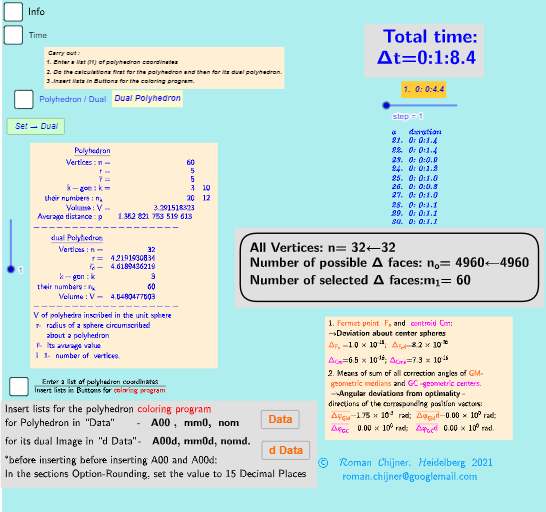
This example demonstrates how to build a Truncated Dodecahedron (with V=60 vertices) starting from a biscribed Pentakis Dodecahedron. The key step is to take its 2nd-order segments and trisection them, then use the resulting subdivision to create the truncated solid and compute/label associated measures such as volumes and radii-related quantities. The mathematical ideas involved are polyhedron truncation, segment trisection as a geometric construction rule, solid geometry relationships, and volume computation within a parameterized construction. In GeoGebra, the construction relies on commands such as Text/TableText for annotations, Sequence together with Div for discretizing the trisection parameter, If and Sum for conditional/aggregate computations, and Element/IndexOf/First to pick specific items from generated sequences. Length is used to evaluate geometric magnitudes, while intermediate variables and points (e.g., r, a, bu, m01/m02, r_m/r_d) feed into final measurement objects like Volsphere, Vol, Vol_r, and Volsphere_d, enabling verification of the constructed configuration. Suitable for high school through early university audiences, especially lessons on 3D geometry, geometric constructions, and math visualization/modelling.
GeoGebra Commands & Parameters
Text("" + p) → txt_pSum(Flatten[Sequence[Append[Sequence[Element[txt_p, i], i, m01(k), m02(k)], " "], k, 1, 5]]) → txtUm1If(bu0, A00, A00d) → A00_0Length(A00_0) → nLength(l2) → läl2Sequence(sgn(Determinant[{Element[A00_0, i1] - Element[A00_0, j], Element[A00_0, i2] - Element[A00_0, j], Element[A00_0, i3] - Element[A00_0, j]}]), j, 1, n) → l01Length(A00d) → zzzSum(Zip[(T * F), T, SysTimeAkt1, F, {1, 1000, 60000, 3600000, 86400000}]) → TimeAbs1Sum(Zip[(T * F), T, SysTimeAkt2, F, {1, 1000, 60000, 3600000, 86400000}]) → TimeAbs2Div(TimeRelab, 3600) → HDiv(TimeRelab - (H * 3600), 60) → MElement(ZwZeit, step) → text10TableText({Append["a duration", Last[ZwZeit, Min[10, Length[ZwZeit]]]]}, "v") → text2cLength(A00) → lm1If(Length[Unique[l01 \ {0}]] ≟ 1, 7, -7) → a7Sum(Zip[(T * F), T, SysTimeAkt0, F, {1, 1000, 60000, 3600000, 86400000}]) → TimeAbs0Div(TimeRelab0, 3600) → H0Div(TimeRelab0 - (H0 * 3600), 60) → M0Text("" + (TimeRelab0 - (H0 * 3600) - (M0 * 60))) → S0aText("" + (TimeRelab - (H * 3600) - (M * 60))) → SIndexOf(".", S) → indexIndexOf(".", S0a) → indexaFirst(S, index + 1) → txtSFirst(S0a, indexa + 1) → txtS0aIf(bu0, " ", "d") → txtbuoMax(Length[A00], Length[A00d]) → maxläElement(A00, 24) → m11TableText({{"\underline{Polyhedron}"}, Append["Vertices: n=", {Length[A00]}], Append["r=", {r}], Append["\bar{r}=", {r_m}], Append["k-gon : k=", mm5a], Append["their\; numbers: n_k=", mm7a], Append["Volume: V=", {Vol_r}], Append["Average\; distance: p=", {txtUm1}]}, "hr ") → text7TableText({{"\underline{dual\;Polyhedron}"}, Append["Vertices: n=", {Length[A00d]}], Append["r=", {r_d}], Append[" \bar{r_d}= ", {r_md}], Append["k-gon : k=", mm5ad], Append["their\; numbers: n_k=", mm7ad], Append["Volume: V=", {Vold_r}]}, "hr ") → text20
AI Drawing Prompt Reference
Describe a truncated dodecahedron (Truncated Dodecahedron) with 60 vertices. It is constructed from a biscribed pentakis dodecahedron (biscribed Pentakis Dodecahedron) by taking its 2nd-order segments and trisecting each segment. The resulting subdivision is used to build the truncated solid. The drawing should include the biscribed pentakis dodecahedron, its 2nd-order segments, the trisected subdivisions, the truncated dodecahedron, and annotations such as vertex count (60), radii (r, r_m), and volume (V). The construction order: first draw the biscribed pentakis dodecahedron, identify its 2nd-order segments, trisect each segment, then use the subdivision to construct the truncated dodecahedron, and finally compute and label geometric quantities.
The prompt above was compiled from the original drawing commands and is for reference only.