
Constructing a Triangular Prism by GeoGebra Materials Team
Loading the math board and drawing, please wait…
In collections
Area, Surface Area, Volume--Nets
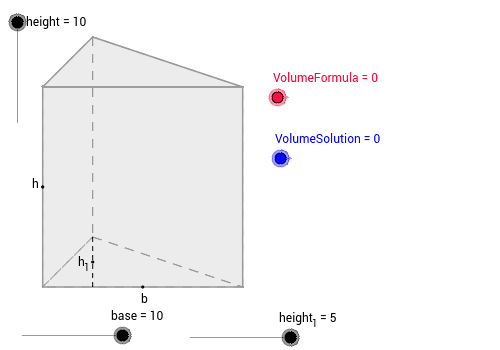
This example demonstrates how to construct a triangular prism using GeoGebra. It involves core mathematical concepts such as prisms, isosceles triangles, parametric curves, logic, cuboids, and line segments. The construction utilizes commands and objects like Dilate (dilation), Vector (vector), Circle (circle), Line (line), Intersect (intersection), Translate (translation), Midpoint (midpoint), Polygon (polygon), Segment (segment), If (conditional logic), and AngularBisector (angle bisector). It is suitable for high school solid geometry instruction and geometric construction learning.
GeoGebra Commands & Parameters
Dilate(F, height, E) → GVector(E, G) → uDilate(I, base, H) → LVector(H, L) → vCircle(J, height_1) → gLine(J, K) → hIntersect(g, h, 1) → MVector(J, M) → wTranslate(A, v) → BCircle(J, 1) → dMidpoint(A, B) → CMidpoint(C, A) → DTranslate(D, Vector[w / 2]) → NPolygon(A, N, B) → P, b, a, nTranslate(A, u) → A'Translate(N, u) → N'Translate(B, u) → B'Polygon(A', N', B') → P', b', a', n'Polygon(A', N', N, A) → Q, a'_1, n'_1, n_1, a_1Polygon(N', N, B, B') → R, n'_2, n_2, b_1, b'_1Polygon(B', B, A, A') → S, b'_2, b_2, a_2, a'_2Segment(N, D) → cMidpoint(A, A') → OMidpoint(N, D) → TIf(VolumeFormula ≟ 1, U) → ZIf(VolumeSolution ≟ 1, V) → A_1AngularBisector(A, N, B) → eAngularBisector(B, A, N) → fIntersect(f, e) → WTranslate(W, u) → Y
AI Drawing Prompt Reference
Please draw a triangular prism constructed from an isosceles triangle and a cube. First, establish an isosceles triangle as the base. Then, use scaling and vector operations to translate it, forming another isosceles triangle as the top. Next, find key points by intersecting a circle and a line, and use translation and circles to create auxiliary figures. Determine vertices using midpoints and translation, and finally connect these vertices with a polygon to form the complete prism. Additionally, add angle bisectors to illustrate geometric relationships.
The prompt above was compiled from the original drawing commands and is for reference only.