
Constructing a Circle Through Three Noncollinear Points
Loading the math board and drawing, please wait…
In collections
Integrated Math Constructions
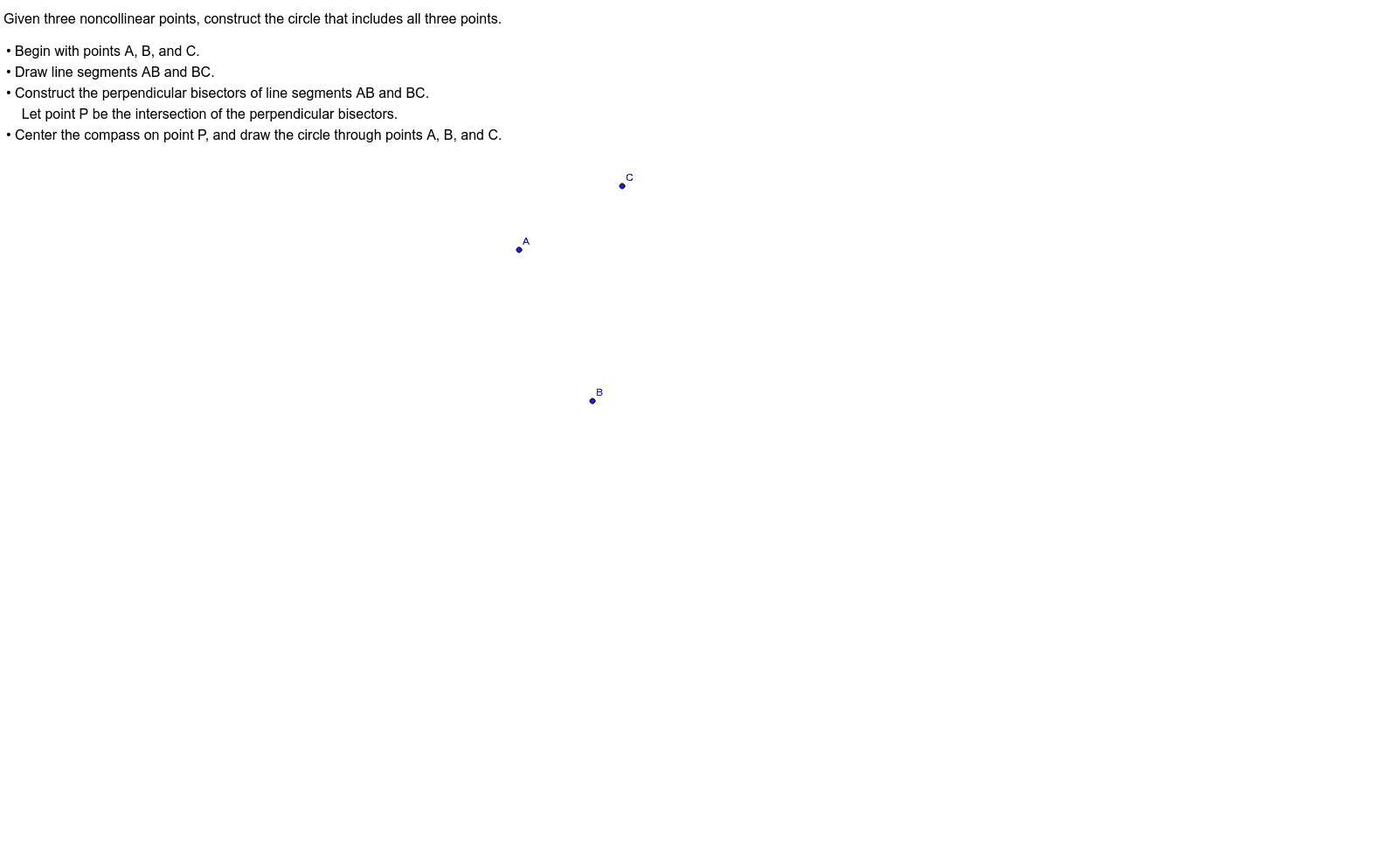
This example demonstrates how to construct the unique circle passing through three given noncollinear points, which is the circumcircle of the triangle formed by these points. The core mathematical concepts involve the definition of a circle (the set of points equidistant from a fixed center) and the property of the circumcenter—the intersection point of the perpendicular bisectors of the triangle's sides, which serves as the circle's center. Construction details: Based on the construction summary, the example uses text objects (text1, text2) for labeling, and creates multiple points (A_1, P_1, C_1, A, C, B) as inputs or auxiliary points. The construction likely employs GeoGebra's perpendicular bisector tool, intersection tool, and circle tool to complete the figure. This is suitable for middle school or high school geometry lessons, helping students understand circumcircles, circumcenters, and the application of perpendicular bisectors. It can also serve as an interactive demonstration where students drag vertices to observe how the circumcircle changes.
GeoGebra Commands & Parameters
Point A_1(-4.48, -2.64)Point P_1(7.68, -2.6)Point C_1(-0.54, 0.38)Point A(7.58, 0.58)Point C(9.94, 2.04)Point B(9.26, -2.88)
AI Drawing Prompt Reference
Draw a circle passing through three noncollinear points, which is the circumcircle of the triangle formed by these points. First place three noncollinear points as triangle vertices)Skip, then connect them to form a triangle. Construct the perpendicular bisector of each side of the triangle; these three bisectors intersect at a single point, which is the circumcenter. Using this intersection as the center and the distance to any vertex as the radius, draw a circle that passes through all three vertices. Label the three vertices and the circumcenter, and show the perpendicular bisectors to illustrate their relationship with the triangle's sides.
The prompt above was compiled from the original drawing commands and is for reference only.