
Cone and Cylinder Cross Sections
Loading the math board and drawing, please wait…
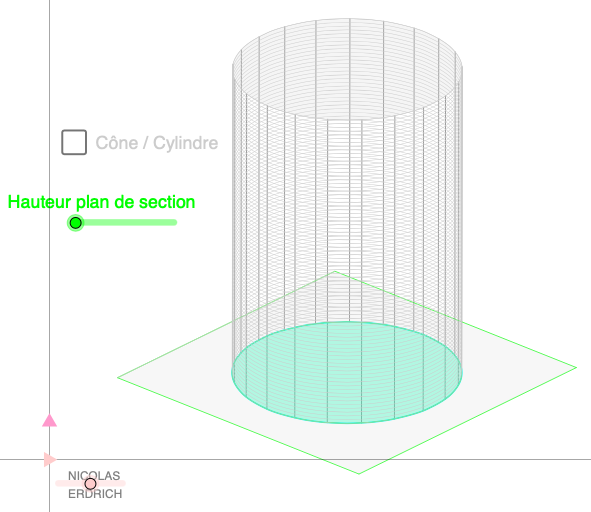
This example demonstrates the cross-sectional shapes formed when a cone or cylinder is intersected by a plane parallel to its base. Key math concepts include solid geometry, cross-sections, similar figures, and properties of cones and cylinders. Construction highlights involve commands like OrthogonalLine, Point, Circle, Vector, Dilate, Conic, Translate, Polygon, Sequence, and more, suitable for high school students learning about solid geometry to visualize the formation and properties of cross-sectional figures.
GeoGebra Commands & Parameters
OrthogonalLine(E, xAxis) → lPoint(l) → P'OrthogonalLine(E, yAxis) → kCircle(O, Zoom) → cPoint(k) → PVector(O, Z) → wVector(O, Y) → vVector(O, X) → uDilate(D, 0.6, O') → D'_3Dilate(C, 0.6, O') → C'_3Dilate(B, 0.6, O') → B'_3Dilate(A, 0.6, O') → A'_3Conic(Y, M_1, X, M_v, M_u) → dConic(Z, X, M_w, M_2, M_u) → eConic(Z, M_3, Y, M_w, M_v) → fTranslate(A, Vector[(hauteur * u)]) → A'Translate(B, Vector[(hauteur * u)]) → B'Translate(C, Vector[(hauteur * u)]) → C'Translate(D, Vector[(hauteur * u)]) → D'Polygon(A', B', C', D') → poly1', a', b', c', d'Translate(B, Vector[(((1 - hauteur3) * hauteur) * u)]) → B'_2Translate(C, Vector[(((1 - hauteur3) * hauteur) * u)]) → C'_2Translate(D, Vector[(((1 - hauteur3) * hauteur) * u)]) → D'_2Translate(A, Vector[(((1 - hauteur3) * hauteur) * u)]) → A'_2Polygon(A'_2, B'_2, C'_2, D'_2) → poly1'', a'_2, b'_2, c'_2, d'_2Sequence(O' + ((b * v) * cos((360 / Nombre * k°) + i°)) + ((w * b) * sin((360 / Nombre * k°) + i°)), k, 0, Nombre) → liste1Translate(liste1, Vector[(hauteur * u)]) → liste2PointIn(poly1') → SSequence(Segment[S, Element[liste1, k]], k, 0, Nombre) → liste3Sequence(Segment[Element[liste2, k], Element[liste1, k]], k, 0, Nombre) → liste4Element(liste1, 1) → P_1Element(liste1, 2) → P_2Element(liste1, 3) → P_3Element(liste1, 4) → P_4Element(liste1, 5) → P_5Conic(P_1, P_2, P_3, P_4, P_5) → hDilate(h, hauteur3, S) → h'_1Translate(S, Vector[((-hauteur) * u)]) → S'Segment(S', S) → jTranslate(A, Vector[((1 - hauteur3) * u)]) → A'_1Translate(B, Vector[((1 - hauteur3) * u)]) → B'_1Translate(C, Vector[((1 - hauteur3) * u)]) → C'_1Translate(D, Vector[((1 - hauteur3) * u)]) → D'_1Translate(S, Vector[(((-hauteur) * hauteur3) * u)]) → S''Translate(h, Vector[(hauteur * u)]) → h'Translate(h, Vector[(((1 - hauteur3) * hauteur) * u)]) → i_1Sequence(Dilate[h, l / n, S], l, 0, n) → cerclesPolygon(B, C, D, A) → poly1, b_1, c_1, d_1, aSequence(Translate[h, Vector[((l * hauteur / n) * u)]], l, 0, n) → cercle2
AI Drawing Prompt Reference
Draw a 3D solid geometry diagram showing a cone and a cylinder with parallel circular bases. The cone's apex is above the cylinder's base, and the cylinder consists of two parallel circular faces connected by vertical side lines. Show internal cross-sections: a plane parallel to the base cuts the cone, producing a smaller circle, and another parallel plane cuts the cylinder, producing a circle equal to the base. Draw radial lines from the cone's apex to the base edge to represent slant heights. Use dashed or semi-transparent lines for hidden parts. Highlight the similarity between the cone's cross-section and the base, and indicate height proportions.
The prompt above was compiled from the original drawing commands and is for reference only.