
Conditions for Parallelogram Demonstration by Ibrahim El Hage
Loading the math board and drawing, please wait…
In collections
Quadrilaterals الرُباعيات
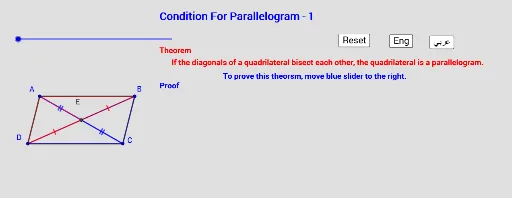
This example demonstrates the conditions and properties of a parallelogram. It involves core mathematical concepts such as parallel lines, diagonals, vectors, and angles. Construction highlights include using GeoGebra commands like Segment, Intersect, Angle, and Polygon. Suitable for high school mathematics education to visually understand geometric properties and proofs of parallelograms.
GeoGebra Commands & Parameters
Segment(A, B) → fSegment(C, D) → gSegment(D, A) → hSegment(C, B) → iSegment(D, B) → jSegment(A, C) → kIntersect(k, j) → ESegment(E, B) → lSegment(E, D) → mSegment(A, E) → nSegment(E, C) → p_1Angle(B, E, A) → αAngle(D, E, C) → βPolygon(A, E, B) → t1, b, a, ePolygon(D, E, C) → t2, c, d, e_1Polygon(E, B, C) → t3, c_1, e_2, b_1Polygon(A, E, D) → t4, d_1, a_1, e_3Angle(C, E, B) → γAngle(A, E, D) → δAngle(B, D, A) → εAngle(D, B, C) → ζAngle(A, B, D) → ηAngle(C, D, B) → θ