
Comprehensive Geometric Construction Combining Similar Triangles, Complex Number
Loading the math board and drawing, please wait…
In collections
About Exponents
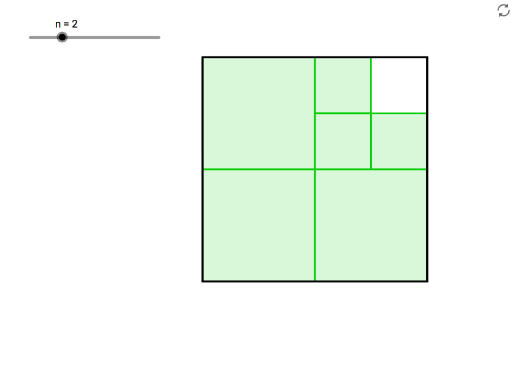
①This example demonstrates a multi-topic geometric construction that integrates similar triangles, hypergeometric distribution, complex numbers, rhombus properties, and scatter plots, built using GeoGebra commands to generate multiple polygons, midpoints, segments, and intersections.②Core mathematical concepts include properties of similar triangles, geometric representation of complex numbers, diagonal perpendicular bisection in a rhombus, probability statistics of hypergeometric distribution, and data visualization via scatter plots.③Construction highlights: from the summary, commands such as Polygon, Midpoint, Segment, Intersect, and Sequence are used, creating multiple polygons (poly1 to poly4), segments (f,g,h,i, etc.), and points (A to O), with a sequence generating list1, possibly for dynamic iteration or visualization.④This is suitable for high school to undergraduate mathematics education, enabling cross-disciplinary exploration of geometry, algebra, and probability, and enhancing students' ability to perform complex constructions with dynamic geometry software.
GeoGebra Commands & Parameters
Polygon(A, B, 4) → poly1, f, g, h, i, C, DMidpoint(D, C) → EMidpoint(C, B) → FMidpoint(B, A) → GMidpoint(A, D) → HSegment(E, G) → jSegment(H, F) → kIntersect(j, k) → IPolygon(H, I, 4) → poly2, l, m, n_1, p, J, KPolygon(A, G, 4) → poly3, q, r, s, t, L, MPolygon(G, B, 4) → poly4, a, b, c, d, N, OSequence(Dilate[LS, 0.5^(k), C], k, 0, n - 1) → list1
AI Drawing Prompt Reference
Draw a complex geometric figure consisting of multiple squares connected by lines, where the squares are formed by connecting midpoints of vertices, the centers of the squares are connected by the intersection points of their diagonals, showcasing the property of perpendicular bisectors of diagonals in rhombuses, and include a dynamic sequence to visualize complex number transformations, creating an interdisciplinary educational example integrating geometry, algebra, and probability statistics.
The prompt above was compiled from the original drawing commands and is for reference only.