
Complex Numbers: Rectangular ↔ Polar Form
Loading the math board and drawing, please wait…
In collections
Trigonometry and Complex Numbers
Trigonometry and Complex Numbers
Trigonometry and Complex Numbers
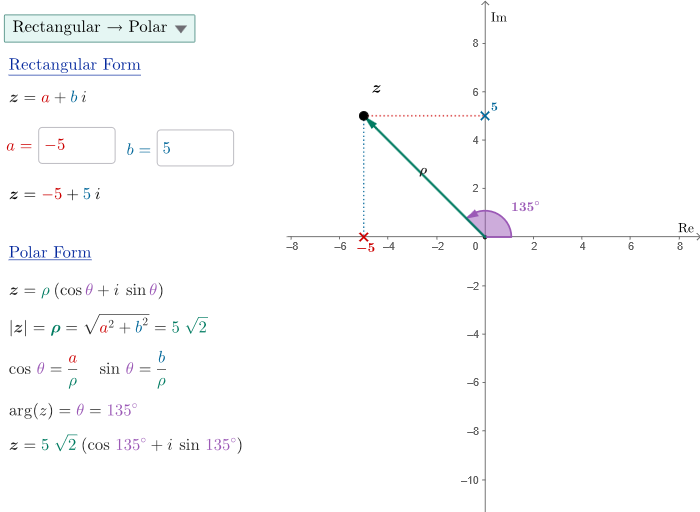
This example demonstrates the conversion between rectangular and polar forms of complex numbers along with their geometric representation. Key math concepts include complex numbers, polar coordinates, rectangular coordinates, vectors, and angles. It utilizes GeoGebra commands like Textfield, Vector, Point, Angle, SelectedIndex, If, Segment, Mod. Suitable for high school and above mathematics learners to understand different representations of complex numbers and their applications.
GeoGebra Commands & Parameters
Textfield(a) → campoInserimento1Textfield(b) → campoInserimento2Vector((0, 0), z) → uPoint(xAxis) → AAngle(A, O, z) → θAlgTextfield(ρ) → campoInserimento3Vector(O, w) → vAngle(A, O, w) → αSelectedIndex(scelte) → isIf(is ≟ 1, (a, b), (x(w), y(w))) → CSegment(C, (x(C), 0)) → fSegment(C, (0, y(C))) → gTextfield(alfa) → campoInserimento4Mod(alfa, 360) → alfaMod
AI Drawing Prompt Reference
Draw a diagram showing the conversion between rectangular and polar forms of complex numbers, including an origin, a complex number vector, its geometric representation in rectangular coordinates (projected line segments on the x and y axes), and in polar coordinates (a line segment from the origin to the point and an angle), with options for users to input the real and imaginary parts of the complex number, and the polar radius and angle, displaying the point position in either coordinate system based on selection.
The prompt above was compiled from the original drawing commands and is for reference only.