
Complex Numbers: Polar and Exponential Forms
Loading the math board and drawing, please wait…
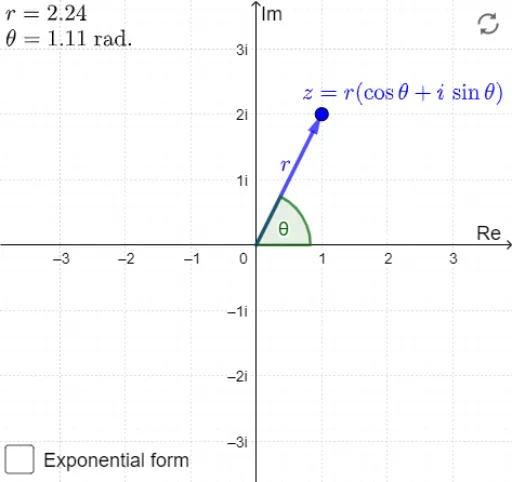
This GeoGebra example visualizes the polar representation (modulus and argument) and exponential form (Euler's formula) of a complex number in the complex plane. It demonstrates how a complex number Z can be expressed as r(cosθ + i sinθ) or re^(iθ), highlighting the geometric meaning of modulus r and argument θ. The construction uses the Vector command to draw the position vector from origin to Z, Angle to mark the argument, Length to compute the modulus, and If to handle quadrant-correct angle display. Text objects text1 and text2 show the algebraic forms. Suitable for high school or introductory university students learning complex numbers, this interactive tool helps bridge algebraic and geometric interpretations and supports classroom demonstrations.
GeoGebra Commands & Parameters
Vector((0, 0), Z) → uAngle((100, 0), (0, 0), Z) → θIf(y(Z) < 0, ((-((θ * π)))) / (180°), ((θ * π)) / (180°)) → bLength(u) → r
AI Drawing Prompt Reference
Draw a complex plane with a point representing a complex number. From the origin, draw an arrowed vector to the point to show its modulus. Mark the angle between the positive real axis and the vector with an arc. Display the polar form (modulus times cosine plus sine imaginary part) and exponential form (modulus times e to the imaginary angle). Adjust the angle sign based on the point's quadrant.
The prompt above was compiled from the original drawing commands and is for reference only.