
Complex Number Operations
Loading the math board and drawing, please wait…
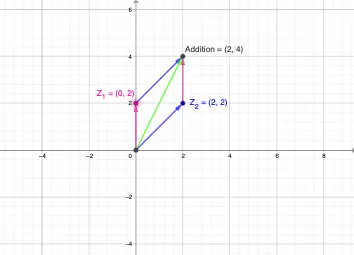
This example demonstrates the addition and multiplication of complex numbers along with their geometric interpretations. Key math concepts include algebraic representation of complex numbers, vector operations, coordinate geometry, and geometric transformations. Constructed using GeoGebra commands like Intersect and Vector, and objects such as vectors and points representing complex numbers. Suitable for high school and university-level mathematics education, aiding in visualizing and understanding complex number operations.
GeoGebra Commands & Parameters
Intersect(xAxis, yAxis) → BVector(B, Z_1) → Z_{1v}Vector(B, Z_2) → Z_{2v}Vector(Z_2, Addition) → uVector(Z_1, Addition) → vVector(B, Addition) → Addition_{1}
AI Drawing Prompt Reference
In a Cartesian coordinate system, plot the origin and two points representing complex numbers Z1 and Z2. Draw vectors from the origin to each of these points to show their vector representations. Construct the sum of these two complex numbers, labeled Addition. Connect vectors from Z1 to Addition and from Z2 to Addition, forming a parallelogram that demonstrates the geometric interpretation of complex addition—the parallelogram law for vector addition.
The prompt above was compiled from the original drawing commands and is for reference only.