
Complex Number Addition by Martin Flashman
Loading the math board and drawing, please wait…
In collections
Mapping Diagrams to Visualize Complex Analysis
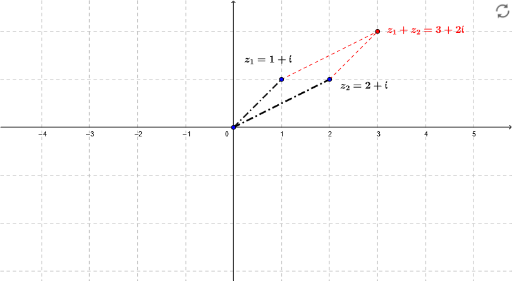
This example demonstrates the process of complex number addition. It shows how to understand complex number addition through the geometric representation of vectors. Using commands from the construction summary, we see the use of complex number objects and vector operations. Suitable for students in middle school and above to learn basic complex number operations.
GeoGebra Commands & Parameters
Angle(z_4, z_3, z_1) → θ_1Segment(z_3, z_1) → r_1Segment(z_3, z_2) → r_2Segment(z_3, z_{z_1+z_2}) → r_{z_1+z_2}Angle(z_4, z_3, z_2) → θ_2Angle(z_4, z_3, z_{z_1+z_2}) → βSegment(z_2, z_{z_1+z_2}) → cCurveCartesian(((1 - t) * x(z_1)) + (t * x(z_{z_1+z_2})), ((1 - t) * y(z_1)) + (t * y(z_{z_1+z_2})), t, 0, 1) → fSegment(z_1, z_{z_1+z_2}) → dSegment(z_2, z_{z_1+z_2}) → e
AI Drawing Prompt Reference
Draw a geometric representation of complex number addition showing two vectors and their sum as a parallelogram. Illustrate the process by drawing the two vectors, their resultant, connecting the points with line segments, and using a curve to show the transition from the first vector to the sum.
The prompt above was compiled from the original drawing commands and is for reference only.