
Complex 1/z: Geometric Visualization of Reciprocal Transformation
Loading the math board and drawing, please wait…
In collections
Mapping Diagrams to Visualize Complex Analysis
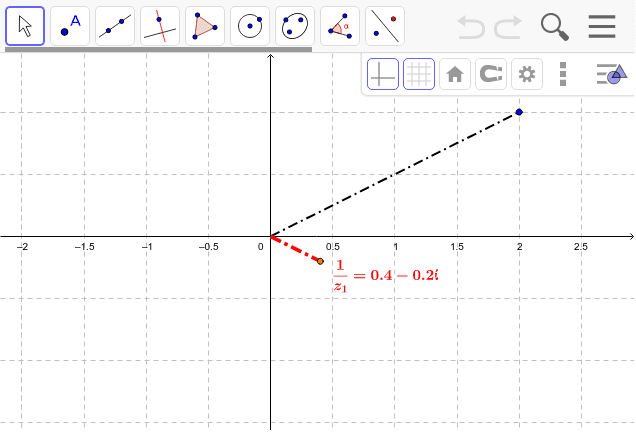
This GeoGebra example dynamically illustrates the geometric relationship between a complex number z and its reciprocal 1/z on the complex plane, showing how the modulus and argument transform under inversion. Core mathematical concepts include complex reciprocal, modulus and argument, and the geometric interpretation of complex multiplication and division. The construction uses commands such as Angle, Segment, and CurveCartesian, with objects like z_1, z_2, their sum, product, reciprocal, and associated radii and angles, enhanced by sliders and text labels (text1 to text5) for dynamic numeric feedback. Suitable for high school and undergraduate students to grasp the visual meaning of complex operations, serving as an introductory tool for complex analysis courses.
GeoGebra Commands & Parameters
Angle(z_4, z_3, z_1) → θ_1Segment(z_3, z_1) → r_1Segment(z_3, z_2) → r_2Segment(z_2, z_{z_1+z_2}) → dSegment(z_1, z_{z_1+z_2}) → eSegment(z_3, z_{z_1*z_2}) → r_{z_1*z_2}Angle(z_4, z_3, z_2) → θ_2Angle(z_4, z_3, z_{z_1*z_2}) → βSegment(z_2, z_{z_1*z_2}) → cCurveCartesian(((1 - t) * x(z_1)) + (t * x(z_{z_1*z_2})), ((1 - t) * y(z_1)) + (t * y(z_{z_1*z_2})), t, 0, 1) → fAngle(z_4, z_3, z_{1/z}) → αSegment(z_3, z_{1/z}) → g