
Complementary, Supplementary and Conjugate Angles
Loading the math board and drawing, please wait…
In collections
Mathematics Form 1
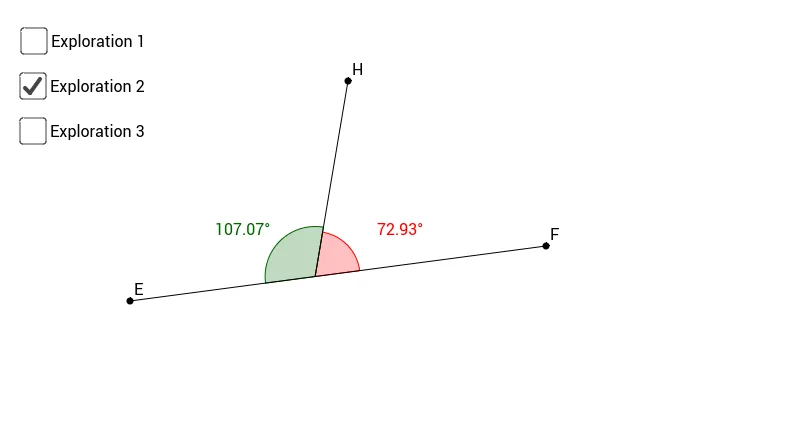
This example demonstrates the formation and relationships between complementary, supplementary, and conjugate angles. It involves core mathematical concepts such as angle measurement, geometric relationships, and symmetry. Construction highlights include using commands like Segment, OrthogonalLine, Circle, Intersect, CircleArc, Point, Angle, SelectedIndex in GeoGebra. Suitable for high school mathematics teaching and geometric learning.
GeoGebra Commands & Parameters
Segment(A, B) → aOrthogonalLine(A, a) → bCircle(A, B) → cIntersect(c, b, 2) → CSegment(A, C) → dCircleArc(A, B, C) → ePoint(e) → DSegment(A, D) → fAngle(B, A, D) → αAngle(D, A, C) → βSegment(E, F) → hPoint(h) → GSegment(G, H) → iAngle(F, G, H) → γAngle(H, G, E) → δSegment(I, J) → kSegment(J, K) → lAngle(K, J, I) → εAngle(I, J, K) → ζSelectedIndex(Bahasa) → nn