
Complementary Angle Measurement Practice
Loading the math board and drawing, please wait…
In collections
Some terms & definitions. Angles, angle pairs, angle measure
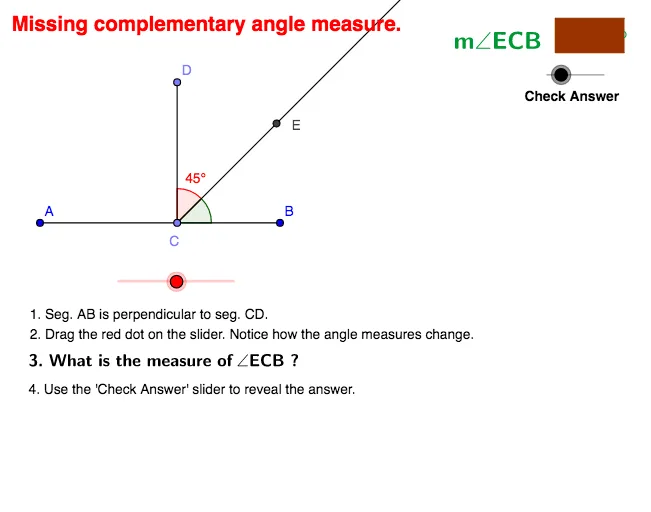
This example demonstrates how to practice measuring complementary angles through geometric construction. Key mathematical concepts include complementary angles, geometric transformations, and angle calculation. Construction involves using GeoGebra commands such as Line, Point, OrthogonalLine, Rotate, etc. Suitable for middle school students or geometry learners.
GeoGebra Commands & Parameters
Line(A, B) → aPoint(a) → COrthogonalLine(C, a) → bSegment(A, B) → dPoint(b) → DSegment(C, D) → eRotate(D, (-α), C) → EAngle(E, C, D) → βRay(C, E) → cAngle(B, C, E) → γPolygon(F, G, H, I) → P, f, g, h, iVector((8, 6), (8 + j, 6)) → uTranslate(F, u) → F'Translate(G, u) → G'Translate(H, u) → H'Translate(I, u) → I'Polygon(F', G', H', I') → P', f', g', h', i'
AI Drawing Prompt Reference
Draw a figure with two complementary angles. First, draw a line AB, then take a point C on the line and draw a perpendicular line b through C. Next, draw a segment AB and take a point D on the perpendicular line, connecting CD. Rotate point D around point C by -α to get point E, and calculate the angle ECD as β. Draw a ray CE and calculate the angle BCE as γ. Construct a quadrilateral FGHI and translate it 8 units to the right and 6 units up to get quadrilateral F'G'H'I'.
The prompt above was compiled from the original drawing commands and is for reference only.