
Complement of a Parallelogram
Loading the math board and drawing, please wait…
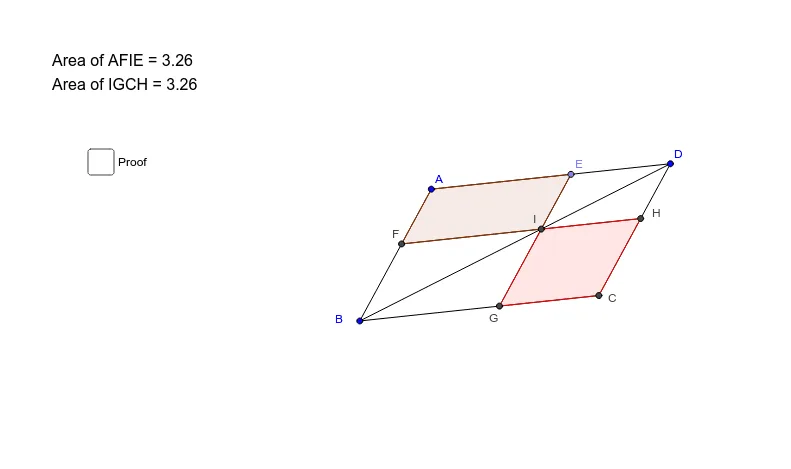
This example demonstrates the geometric relationship and area calculation of a parallelogram and its complement. It involves core math concepts like parallelogram properties, vector operations, area formulas, and coordinate geometry. Construction highlights include using commands like Segment, Line, Intersect, Point, Polygon to build the parallelogram and its complement, focusing on point, line, and polygon object creation and intersection calculations. Suitable for high school mathematics teaching, illustrating vector and area applications in geometry.
GeoGebra Commands & Parameters
Segment(A, B) → aSegment(A, D) → bLine(D, a) → cLine(B, b) → dIntersect(c, d) → CSegment(B, C) → eSegment(C, D) → fPoint(b) → ELine(E, a) → gIntersect(g, e) → GSegment(D, B) → hIntersect(g, h) → ILine(I, b) → iIntersect(i, a) → FIntersect(i, f) → HSegment(F, H) → jSegment(E, G) → kPolygon(A, F, I, E) → poly1, a_1, h_1, g_1, e_1Polygon(I, G, C, H) → poly2, g_2, f_1, d_1, i_1Polygon(F, B, I) → poly3, i_2, f_2, b_1Polygon(B, I, G) → poly4, g_3, b_2, i_3Polygon(D, I, H) → poly5, h_2, d_2, i_4Polygon(E, I, D) → poly6, d_3, e_2, i_5