
Combinatorics: Combination without Repetition
Loading the math board and drawing, please wait…
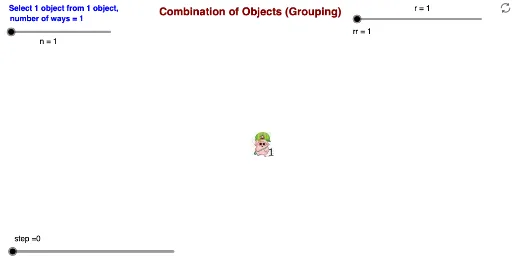
This example demonstrates calculating the number of combinations that can be formed by selecting rr objects from n different objects. It involves core combinatorics concepts like the combination formula nCr. GeoGebra commands used include nCr, Element, If, Sequence, Join, Polygon, with objects like Combine series and nCr. Suitable for high school mathematics teaching and combinatorics learning.
GeoGebra Commands & Parameters
nCr(NObj, rObj) → nCrElement(AdjustSet, NObj) → AdjustIf(nCr > CutValue, CutValue, nCr) → nlist1If(nCr > CutValue, nCr - CutValue, 0) → nlist2Element(SmallRSet, NObj) → SmallRSequence(((a * cos(((360 * tt) * ° / nlist1))), (b * sin(((360 * tt) * ° / nlist1)))), tt, 1, nlist1) → OrbitLarge1Sequence(((a2 * cos(((360 * tt) * ° / nlist2))), (b2 * sin(((360 * tt) * ° / nlist2)))), tt, 1, nlist2) → OrbitLarge2Sequence(Sequence[(x(Element[OrbitLarge1, ss]) - Adjust + (SmallR * cos(((360 * tt) * ° / rr))), y(Element[OrbitLarge1, ss]) + (SmallR * sin(((360 * tt) * ° / rr)))), tt, 1, rr], ss, 1, nlist1) → OrbitSmall1Sequence(Sequence[(x(Element[OrbitLarge2, ss]) - Adjust + (SmallR * cos(((360 * tt) * ° / rr))), y(Element[OrbitLarge2, ss]) + (SmallR * sin(((360 * tt) * ° / rr)))), tt, 1, rr], ss, 1, nlist2) → OrbitSmall2Join({OrbitLarge1, OrbitLarge2}) → OrbitJoinLargeJoin({OrbitSmall1, OrbitSmall2}) → OrbitJoinSmallSequence((i - NObj / 2 - 0.8, 0), i, 1, NObj) → InitialPointSequence(Sequence[(i - NObj / 2 - 0.8, 0), i, 1, NObj], j, 1, nCr) → InitialPointSetElement(Element[Element[Element[Combine00, 6], 3], 2], 3) → test01Element(FinalPoint, 4) → test03Sequence(Sequence[(FindCor(tt, 0, 20, x(Element[Element[InitialPointSet, i], j]), x(Element[Element[FinalPointSet, i], j])), FindCor(tt, 0, 20, y(Element[Element[InitialPointSet, i], j]), y(Element[Element[FinalPointSet, i], j]))), j, 1, NObj], i, 1, nCr) → MovingPointSetSequence(Sequence[(If[tt < i - 1, x(Element[Element[InitialPointSet, i], j]), If[tt > i, x(Element[Element[FinalPointSet, i], j]), FindCor(tt, i - 1, i, x(Element[Element[InitialPointSet, i], j]), x(Element[Element[FinalPointSet, i], j]))]], If[tt < i - 1, y(Element[Element[InitialPointSet, i], j]), If[tt > i, y(Element[Element[FinalPointSet, i], j]), FindCor(tt, i - 1, i, y(Element[Element[InitialPointSet, i], j]), y(Element[Element[FinalPointSet, i], j]))]]), j, 1, NObj], i, 1, nCr) → MovingPointSet2Element(Element[MovingPointSet, 2], 4) → test02Polygon(Point01, Point02, Point03, Point04) → poly1, point01, point02, point03, point04
AI Drawing Prompt Reference
Create a visual representation of combinatorial mathematics, featuring two concentric circular orbits of different sizes representing combinations of selecting r objects from n distinct ones. The larger orbit is divided into two parts, corresponding to the upper and lower limits of the combination number. Smaller orbits rotate around the larger ones, illustrating the distribution of combinations. At the center, there are two sets of points showing initial and final positions, connected by lines indicating movement paths. The overall design is suitable for teaching combinatorial formulas and probability geometry.
The prompt above was compiled from the original drawing commands and is for reference only.