
Clock Geometry Construction
Loading the math board and drawing, please wait…
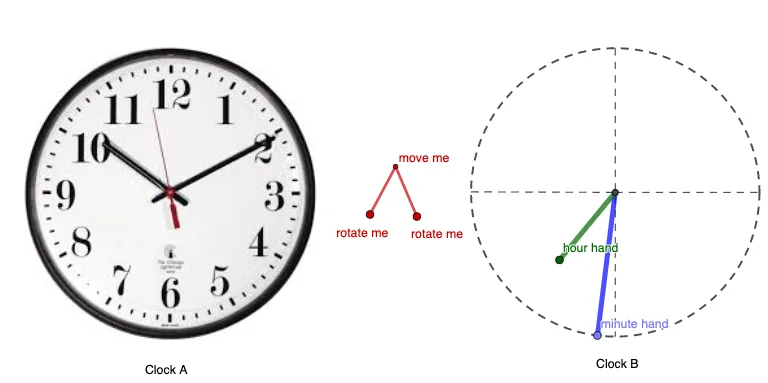
This example demonstrates how to construct a clock model using geometric methods. It involves core mathematical concepts such as circles, angles, geometric construction, and coordinate systems. Key GeoGebra commands used include Intersect, Point, Circle, Ray, Segment, and OrthogonalLine. Suitable for high school mathematics teaching, explaining geometric construction and properties of circles.
GeoGebra Commands & Parameters
Intersect(xAxis, yAxis) → APoint(xAxis) → BCircle(A, B) → cRay(A, B) → fPoint(c) → CRay(A, C) → gSegment(A, C) → hPoint(c) → DSegment(A, D) → iPoint(c) → ESegment(E, A) → jOrthogonalLine(A, i) → kIntersect(c, k, 2) → FIntersect(c, k, 1) → GSegment(F, G) → lPoint(c) → JSegment(A, J) → mCircle(A, K) → dPoint(d) → LSegment(L, A) → nCircle(M, 2) → ePoint(e) → OPoint(e) → PSegment(O, M) → pSegment(P, M) → q
AI Drawing Prompt Reference
Start by drawing a circle centered at the origin with a radius equal to the distance from the origin to a point on the horizontal axis. From the center, draw a ray along the horizontal axis. Place several points on the circle and connect each to the center with line segments. Then, construct a line through the center perpendicular to one of these radius segments, intersecting the circle at two points; connect these two points to form a diameter. Add another point on the circle and connect it to the center. Next, draw a smaller circle centered at a different pointaine, place a point on it, and connect that point to its center. Finally, draw a circle with radius 2 centered at another point, place two points on it, and connect each to the center.
The prompt above was compiled from the original drawing commands and is for reference only.