
City Bus Problem
Loading the math board and drawing, please wait…
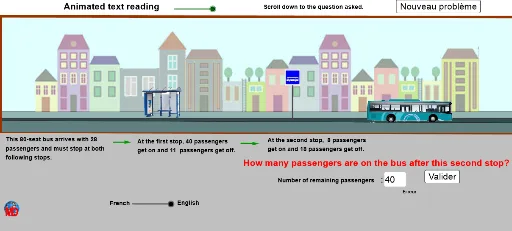
This example demonstrates the city bus problem, involving core concepts of conditional probability and binomial distribution. Using GeoGebra commands such as Random, Point, Segment, etc., a probability model of random events can be constructed. Suitable for high school mathematics education, particularly for learning probability and conditional probability.
GeoGebra Commands & Parameters
Random(10, 20) → bbRandom(5, 10) → ccRandom(10, 20) → ddRandom(30, 40) → aaRandom(20, 30) → mmPoint(xAxis) → CPoint(xAxis) → FSegment(C, F) → aPolygon(C, G, H, F) → poly1, c, g, h, fPolygon(C, I, J, F) → poly2, c_1, i, j, f_1Polygon(I, K, L, J) → poly3, i_1, k, l, j_1Vector(M, N) → uVector(O, P) → vPolygon(Q, R, S, T) → poly4, q, r, s, t_1Textfield(texte9) → ChampTexte1If(b ≟ false, texte8, texte9) → texte10If(Text["" + rep] ≟ texte9, 1, 0) → vraiMirror(Q, k) → Q'Mirror(R, k) → R'Mirror(S, k) → S'Mirror(T, k) → T'Polygon(Q', R', S', T') → poly4', q', r', s', t'