
Circumcircle of a Triangle in a Cube
Loading the math board and drawing, please wait…
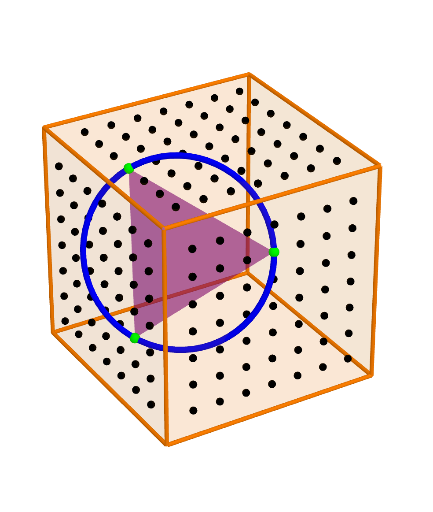
①This example constructs a triangle from three points inside a three-dimensional cube and draws its circumcircle, visually demonstrating the position of a spatial triangle's circumcircle. ②Core mathematical concepts include solid geometry (points, lines, planes in 3D), the definition of a triangle's circumcircle (the circle passing through all three vertices), and the role of cube symmetry in the construction. ③Construction details: Based on the summary, GeoGebra commands such as Point, Cube, Polygon, Circle, RandomElement, Flatten, and Area are used; objects include cube faces (face1~face4), edges (edge1~edge5), and buttons (button1, button2) to trigger random generation. ④Suitable for high school or college solid geometry courses, this dynamic visualization helps students understand the concept of a spatial triangle's circumcircle and observe how it varies with randomly chosen points on the cube.
GeoGebra Commands & Parameters
Point(Circle[(4, -4, -4), Distance[(-4, -4, -4), (4, -4, -4)], Segment[(-4, -4, -4), (4, -4, -4)]]) → AFlatten(Sequence[Sequence[(a, b, 4), a, -3, 3], b, -3, 3]) → l3RandomElement(l3) → SFlatten(Sequence[Sequence[(a, -4, b), a, -3, 3], b, -3, 3]) → l2RandomElement(l2) → RFlatten(Sequence[Sequence[(4, a, b), a, -3, 3], b, -3, 3]) → l1RandomElement(l1) → QCube((-4, -4, -4), (4, -4, -4), A) → a, B, faceABFE, faceCDEF, edge2, edge1, edge4, edgeAB, edge3, edgeBF, edgeCF, edgeCD, C, edge5, edgeDE, edgeAE, edgeEF, D, E, F, face1, face3, face2, face4Polygon(Q, R, S) → t1, f, g, hDotPlot(data, true) → l16BoxPlot(-1, 0.5, data, true) → bCircle(Q, R, S) → cArea(c) → d
AI Drawing Prompt Reference
Inside a 3D cube, randomly select three points to form a triangle and draw its circumcircle, visually demonstrating the position of the circumcircle for a spatial triangle. The cube consists of six faces and twelve edges. The triangle is defined by these three random points, and the circumcircle passes through all three vertices. The construction dynamically shows how the circumcircle varies with different point positions, suitable for high school or college solid geometry education.
The prompt above was compiled from the original drawing commands and is for reference only.