
Triangle of Lights: Relativity Spacetime Diagram and Geometric Construction
Loading the math board and drawing, please wait…
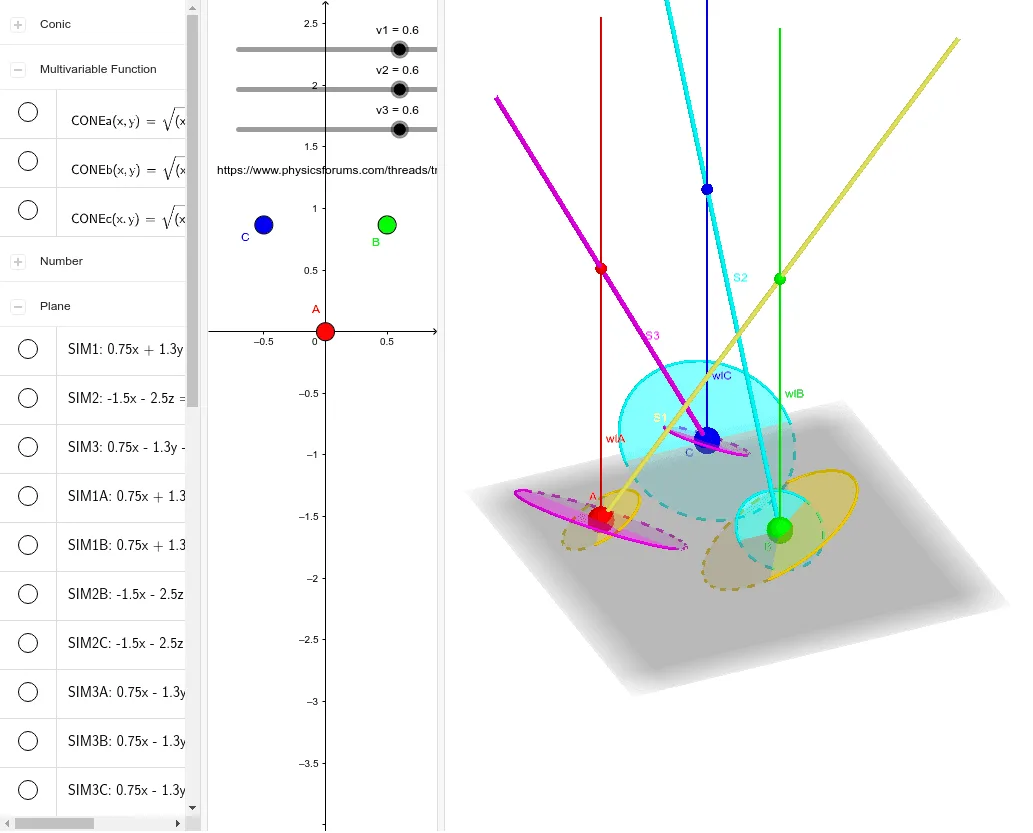
This example demonstrates a triangular light-cone system formed by three sources (A, B, C) within a relativity spacetime diagram, illustrating the interaction between light cones and geometric structures. Core mathematical concepts include 3D conical surfaces, geometric representation of light propagation, similarity transformations, and combinations of triangles and circles. Construction highlights: using GeoGebra commands Ray, Intersect, and Circle to create base elements, then building three light cones (CONEa, CONEb, CONEc) and applying similarity transformations via SIM series objects to form a complex spatial arrangement. Suitable for high school and university students in physics or mathematics courses to explore relativity spacetime diagrams, 3D geometric constructions, and similarity transformations.
GeoGebra Commands & Parameters
Ray(B, B + (0, 0, 1)) → wlBRay(A, A + (0, 0, 1)) → wlARay(C, C + (0, 0, 1)) → wlCRay(A, B + (0, 0, 1 / v1)) → S1Ray(C, A + (0, 0, 1 / v3)) → S3Intersect(S3, h3) → P3, ERay(B, C + (0, 0, 1 / v2)) → S2Intersect(S2, h2) → P2,Intersect(S1, h1) → P1,Circle(B, 0.5, Vector[((2 * (x(P1) - x(A))), (2 * (y(P1) - y(A))), (-2 * (z(P1) - z(A))))]) → SIMc1BCircle(C, 0.5, SIM2) → SIMc2CCircle(A, 0.5, SIM3) → SIMc3ACircle(C, 0.25, SIM3) → SIMc3CCircle(B, 0.25, SIM2) → SIMc2BCircle(A, 0.25, SIM1) → SIMc1AIntersect(S3, wlA) → S3AIntersect(S2, wlC) → S2CIntersect(S1, wlB) → S1B
AI Drawing Prompt Reference
Create a 3D diagram using three source points A, B, and C. From each point draw ray boundaries in a common direction, then use different speed parameters to define three sets of light-cone surfaces. For each cone, intersect it with its corresponding auxiliary plane or surface to obtain key intersection points P1, P2, and P3 (and the related intersection elements used for positioning). Then construct circular features associated with the sources: draw circles centered at B, C, and A with radii 0.5 and 0.25, and orient/locate each circle using the direction determined by the vector relationship from the intersection point to the relevant source. Use the circle boundaries along with intersections with the rays to assemble the overall triangular arrangement of the interacting light-cone system.
The prompt above was compiled from the original drawing commands and is for reference only.