
Centroid, Orthocenter, and Circumcenter of a Triangle by Dylan
Loading the math board and drawing, please wait…
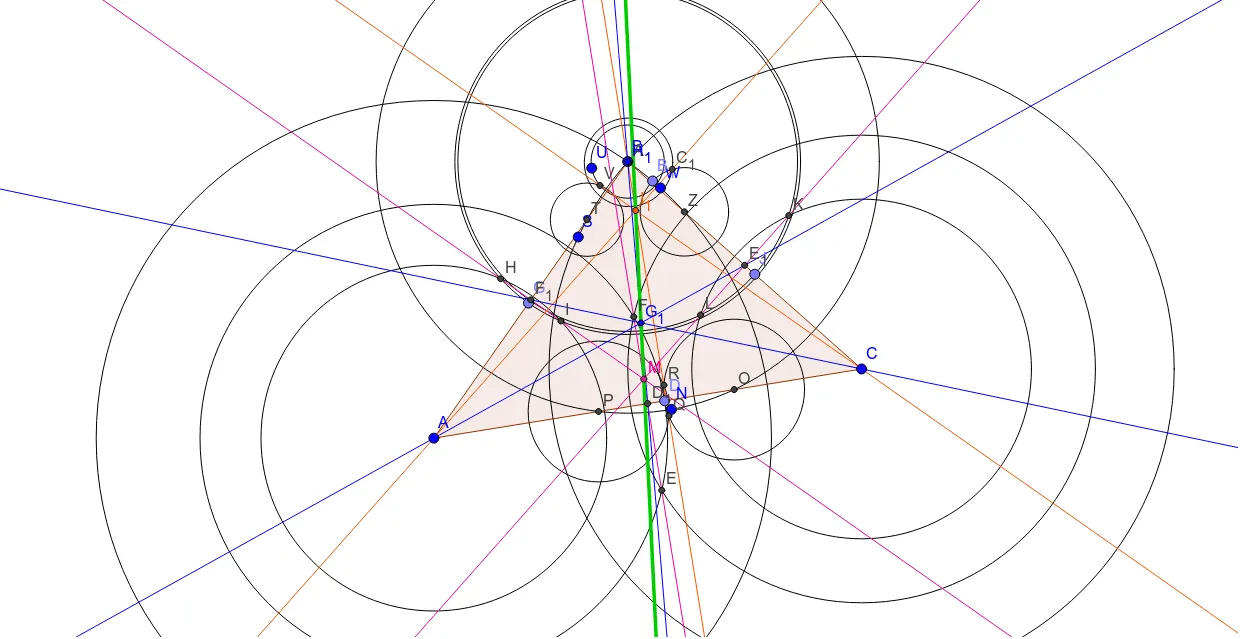
This GeoGebra example demonstrates the centroid, orthocenter, and circumcenter of a triangle and their geometric relationships. It covers core concepts such as medians, altitudes, perpendicular bisectors, triangle centers, and the circumcircle. The construction uses Polygon to create triangle poly1, Point to define vertices A, B, C and intersection points, Line to draw medians, altitudes, or perpendicular bisectors, Circle to construct the circumcircle, and Intersect to locate centers and key points. Suitable for middle-school geometry, high-school Euclidean geometry, and exploratory math labs.
GeoGebra Commands & Parameters
Polygon(A, B, C) → poly1, c, a, bPoint(poly1) → DCircle(A, Segment[A, D]) → dCircle(C, Segment[A, D]) → eIntersect(d, e, 2) → EIntersect(d, e, 1) → FLine(E, F) → fPoint(poly1) → GCircle(B, Segment[B, G]) → gCircle(A, Segment[B, G]) → hIntersect(g, h, 2) → HIntersect(g, h, 1) → ILine(H, I) → iPoint(poly1) → JCircle(B, Segment[B, J]) → kCircle(C, Segment[B, J]) → pIntersect(k, p, 1) → KIntersect(k, p, 2) → LLine(K, L) → jIntersect(f, i) → MCircle(B, N) → qIntersect(q, b, 1) → OIntersect(q, b, 2) → PCircle(O, D) → rCircle(P, Segment[O, D]) → sIntersect(r, s, 1) → QIntersect(r, s, 2) → RLine(Q, R) → lCircle(C, S) → tIntersect(t, c, 1) → TCircle(B, U) → c_1Circle(T, Segment[B, U]) → d_1Intersect(c_1, d_1, 2) → VLine(V, C) → mCircle(A, W) → e_1Intersect(e_1, a, 2) → ZIntersect(e_1, a, 1) → A_1Point(e_1) → B_1Circle(Z, B_1) → f_1Circle(A_1, Segment[Z, B_1]) → g_1Intersect(f_1, g_1, 2) → C_1Line(C_1, A) → nIntersect(f, b) → D_1Intersect(j, a) → E_1Intersect(i, c) → F_1Line(F_1, C) → a_1Line(D_1, B) → b_1Line(E_1, A) → h_1Intersect(a_1, b_1) → G_1Line(M, G_1) → i_1Intersect(t, c, 2) → H_1Intersect(l, m) → I_1
AI Drawing Prompt Reference
Draw a triangle with three vertices. Pick a point inside the triangle, draw a circle centered at that point with radius to one vertex, and another circle centered at another vertex with the same radius; the line through their two intersections is constructed. Repeat this with two other interior points to get three such lines. These lines intersect pairwise at three points on the triangle's sides. Then, from one vertex, draw a circle with a suitable radius intersecting the opposite side, and from that intersection draw another circle with the same radius; the line through their intersections is a perpendicular. Construct two more perpendiculars similarly. Finally, each perpendicular meets its corresponding side at a foot, and lines from each vertex to the opposite foot form the three altitudes.
The prompt above was compiled from the original drawing commands and is for reference only.