
Centroid of a Planar Region and Curve
Loading the math board and drawing, please wait…
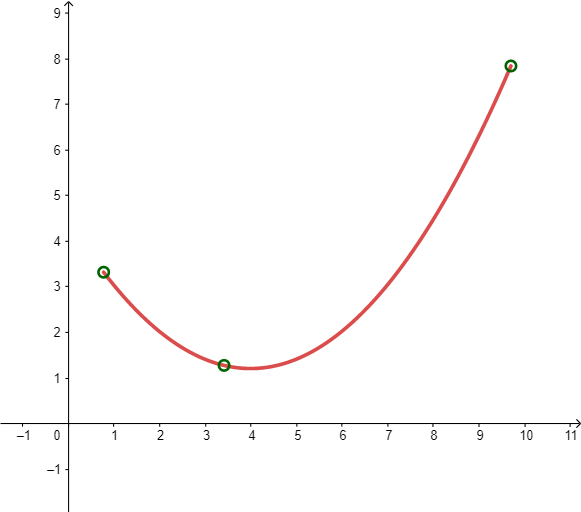
This example demonstrates how to calculate the centroid of a planar region and curve. It involves core mathematical concepts like integration, coordinate geometry, functions, and optimization. GeoGebra commands and objects such as Max, Min, Polynomial, If, Integral, Element, Segment, and IntegralBetween are used in the construction. Suitable for high school and above students to understand centroid calculation and geometric construction methods.
GeoGebra Commands & Parameters
Max({x(P), x(Q), x(R)}) → bMin({x(P), x(Q), x(R)}) → aPolynomial({P, Q, R}) → fIf(tfCrv, sqrt(1 + (f'(x))^(2)), 0) → rIntegral(r(x), a, b) → LIf(tfCrv, (1 / L * Integral[(f(x) * r(x)), a, b]), 0) → crvYbarIf(tfCrv, (1 / L * Integral[(x * r(x)), a, b]), 0) → crvXbarElement(KeepIf[x(P) ≟ b, P, {P, Q, R}], 1) → MaxPtElement(KeepIf[x(P) ≟ a, P, {P, Q, R}], 1) → MinPtSegment(MinPt, MaxPt) → hIntegralBetween(f(x), h(x), a, b) → ArIntIf(tfReg, (1 / A * Integral[(x * abs(f(x) - h(x))), a, b]), 0) → regXbarIf(tfReg, (1 / A * Integral[((f(x) + h(x)) / 2 * abs(f(x) - h(x))), a, b]), 0) → regYbar
AI Drawing Prompt Reference
In a coordinate plane, start with three given points and build a polynomial function that represents the curve segment. Determine the integration bounds using the minimum and maximum x-values among the three points. Define the arc-length density along the curve as r(x)=sqrt(1+(f'(x))^2) where applicable, then integrate r(x) over the interval to get the total arc length L. Compute the curve centroid by calculating x̄=(1/L)∫(x·r(x))dx and ȳ=(1/L)∫(f(x)·r(x))dx, and place/label the centroid location accordingly. Then define the planar region between the curve f(x) and the boundary function h(x), use the weight |f(x)−h(x)| in area integrals over the same interval to compute the region centroid x̄ and ȳ, and indicate these centroid positions on the same plot.
The prompt above was compiled from the original drawing commands and is for reference only.