
Cavalieri's Principle: Volume Equality of Solids with Equal Cross-Sections
Loading the math board and drawing, please wait…
In collections
Geometry - Area & Volume
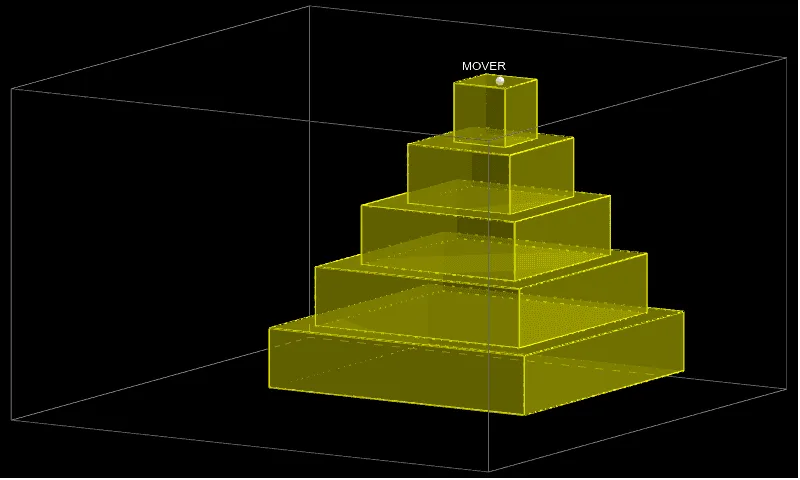
This GeoGebra example demonstrates Cavalieri's Principle by constructing cubes and prisms and comparing their parallel cross-sectional areas to show that solids with equal height and equal corresponding cross-sectional areas have equal volumes. Core mathematical concepts include solid geometry, volume invariance, cross-sectional area, parallel slicing, and the conceptual bridge to definite integrals and volume formulas. The construction employs GeoGebra commands Cube, Prism, Plane, Intersect, Polygon, Segment, Line, Circle, and PointIn, creating vertices A–H, face objects such as caraABDC and caraBDHE, edge objects such as aristaBD and aristaAB, and auxiliary points I, K, L, M, N, Q, R with segments b, c, d, e, j for dynamic cross-section visualization. It is suitable for high school solid geometry instruction and as an intuitive aid for introducing volume by integration in university calculus.
GeoGebra Commands & Parameters
Cube(B, A, xOyPlane) → a, C, caraACGF, caraCDHG, caraEFGH, aristaBD, aristaAB, aristaAC, aristaCD, aristaBE, aristaDH, aristaEH, D, aristaEF, aristaAF, aristaFG, aristaCG, aristaGH, E, F, G, H, caraABDC, caraBDHE, caraABEFIntersect(xAxis, yAxis) → IPlane(K, xOyPlane) → cPointIn(caraEFGH) → MOVERSegment(MOVER, A) → bIntersect(b, c) → LLine(L, xAxis) → dCircle(L, 5.7, c) → eIntersect(d, e) → M, NPlane(Q, c) → jIntersect(b, j) → RLine(R, d) → kCircle(R, 5.4, j) → pIntersect(k, p) → S, TPlane(W, j) → oIntersect(b, o) → ZLine(Z, d) → rCircle(Z, 5.1, o) → sIntersect(r, s) → A_1, B_1Plane(E_1, o) → uIntersect(b, u) → F_1Line(F_1, d) → d_1Circle(F_1, 4.8, u) → e_1Intersect(d_1, e_1) → G_1, H_1Polygon(F_1, H_1, 4, u) → polígono4, f_1, g_1, h_1, i_1, I_1, J_1Plane(K_1, u) → vIntersect(b, v) → L_1Line(L_1, d) → j_1Circle(L_1, 4.5, v) → k_1Intersect(j_1, k_1) → M_1, N_1Plane(Q_1, v) → wIntersect(b, w) → R_1Line(R_1, d) → q_1Circle(R_1, 4.2, w) → r_1Intersect(q_1, r_1) → S_1, T_1Plane(W_1, w) → o_1Intersect(b, o_1) → Z_1Line(Z_1, d) → c_2Circle(Z_1, 3.9, o_1) → d_2Intersect(c_2, d_2) → A_2, B_2Plane(E_2, o_1) → u_1Intersect(b, u_1) → F_2Line(F_2, d) → i_2Circle(F_2, 3.6, u_1) → k_2Intersect(i_2, k_2) → G_2, H_2Polygon(F_2, H_2, 4, u_1) → polígono8, j_2, l_2, m_2, n_2, I_2, J_2Plane(K_2, u_1) → v_1Intersect(b, v_1) → L_2Line(L_2, d) → p_2Circle(L_2, 3.3000000000000003, v_1) → q_2Intersect(p_2, q_2) → M_2, N_2Plane(Q_2, v_1) → w_1Intersect(b, w_1) → R_2Line(R_2, d) → b_3Circle(R_2, 3, w_1) → c_3Intersect(b_3, c_3) → S_2, T_2Plane(W_2, w_1) → o_2Intersect(b, o_2) → Z_2Line(A_3, b) → h_3Line(Z_2, d) → i_3Circle(Z_2, 2.7, o_2) → k_3Intersect(i_3, k_3) → B_3, C_3Plane(F_3, o_2) → u_2Intersect(b, u_2) → G_3Line(G_3, d) → p_3Circle(G_3, 2.4000000000000004, u_2) → q_3Intersect(p_3, q_3) → H_3, I_3Polygon(G_3, I_3, 4, u_2) → polígono12, r_3, s_3, t_3, a_4, J_3, K_3Plane(L_3, u_2) → v_2Intersect(b, v_2) → M_3Line(M_3, d) → b_4Circle(M_3, 2.1, v_2) → c_4Intersect(b_4, c_4) → N_3, O_3Plane(R_3, v_2) → w_2Intersect(b, w_2) → S_3Line(S_3, d) → h_4Circle(S_3, 1.7999999999999998, w_2) → k_4Intersect(h_4, k_4) → T_3, U_3Plane(Z_3, w_2) → o_3Intersect(b, o_3) → A_4Line(A_4, d) → n_4Circle(A_4, 1.5, o_3) → p_4Intersect(n_4, p_4) → B_4, C_4Plane(F_4, o_3) → u_3Intersect(b, u_3) → G_4Line(G_4, d) → a_5Circle(G_4, 1.2000000000000002, u_3) → c_5Intersect(a_5, c_5) → H_4, I_4Polygon(G_4, I_4, 4, u_3) → polígono16, b_5, d_5, e_5, f_5, J_4, K_4Plane(L_4, u_3) → v_3Intersect(b, v_3) → M_4Line(M_4, d) → g_5Circle(M_4, 0.9000000000000004, v_3) → h_5Intersect(g_5, h_5) → N_4, O_4Plane(R_4, v_3) → w_3Intersect(b, w_3) → S_4Line(S_4, d) → m_5Circle(S_4, 0.6000000000000005, w_3) → p_5Intersect(m_5, p_5) → T_4, U_4Plane(Z_4, w_3) → o_4Intersect(b, o_4) → A_5Line(A_5, d) → t_5Circle(A_5, 0.2999999999999998, o_4) → c_6Intersect(t_5, c_6) → B_5, C_5Polygon(B, A, C, D) → polígono20, b_7, a_7, c_7, d_7Prism(polígono20, 1.2) → u_4, V_2, arista1, arista2, arista3, arista4, arista5, arista6, arista7, arista8, D_3, E_3, P_3, cara1, cara2, cara3, cara4, cara5Prism(polígono4, 1.2) → u_5, D_2, arista33, arista34, arista35, arista36, arista37, arista38, arista39, arista40, O_2, P_2, U_2, cara21, cara22, cara23, cara24, cara25Prism(polígono8, 1.2) → g_6, J, arista9, arista10, arista11, arista12, arista13, arista14, arista15, arista16, O, P, U, cara6, cara7, cara8, cara9, cara10Prism(polígono12, 1.2) → k_6, V, arista17, arista18, arista19, arista20, arista21, arista22, arista23, arista24, C_1, D_1, O_1, cara11, cara12, cara13, cara14, cara15Prism(polígono16, 1.2) → o_6, P_1, arista25, arista26, arista27, arista28, arista29, arista30, arista31, arista32, U_1, V_1, C_2, cara16, cara17, cara18, cara19, cara20