
Calculate the Volume of a Solid by Summing Planes
Loading the math board and drawing, please wait…
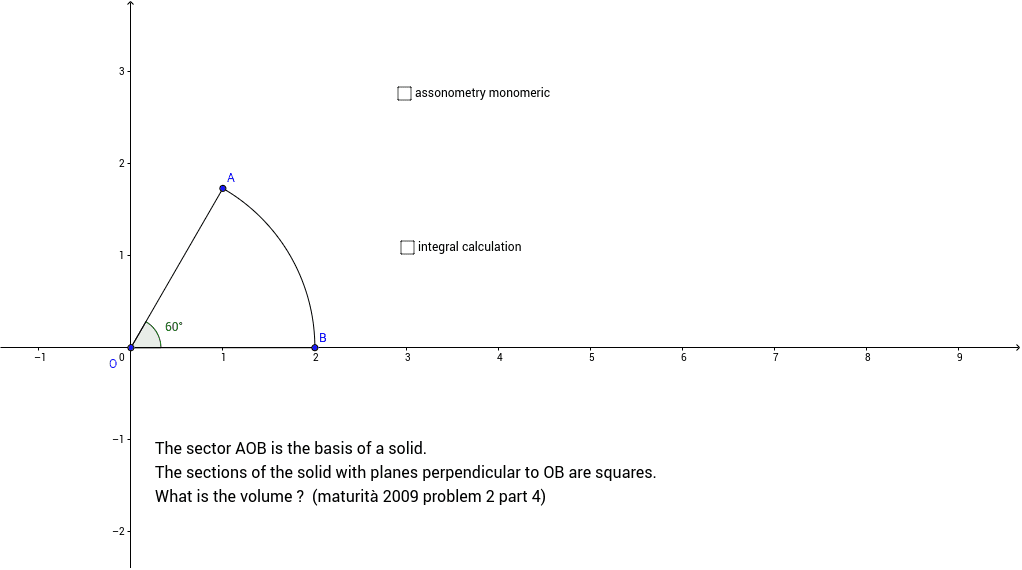
This example demonstrates how to construct a solid by summing planes and calculating its volume. Key mathematical concepts include solid geometry and integration. Using GeoGebra commands such as Intersect, Segment, Rotate, etc., the process of geometric transformations and integration is visually illustrated. Suitable for high school and above students or teachers.
GeoGebra Commands & Parameters
Intersect(xAxis, yAxis) → OSegment(O, A) → aSegment(O, B) → cCircleArc(O, B, A) → dRotate(O, 330*°, O) → O'Rotate(B, 330*°, O) → B'Segment(O', B') → c'Rotate(d, 330*°, O) → d'Rotate(O, 330*°, O) → O'_1Rotate(A, 330*°, O) → A'Segment(O'_1, A') → a'OrthogonalLine(P, c') → eIntersect(d, d') → C, , ,Intersect(d, d', 1) → DIntersect(d', e) → E,Intersect(e, a') → FCircle(F, P) → hCircle(P, F) → kIntersect(g, k) → I, JOrthogonalLine(P, c) → iOrthogonalLine(E, c) → jCircle(P, E) → pIntersect(p, i) → K, LCircle(E, P) → qIntersect(q, j) → M, NSegment(L, N) → nSegment(E, N) → sSegment(P, F) → lSegment(P, E) → mOrthogonalLine(A', c') → a_1Intersect(c', a_1) → QOrthogonalLine(Q, c) → b_1OrthogonalLine(A', c) → c_1Circle(Q, A') → d_1Intersect(d_1, b_1) → R, SSegment(S, Q) → e_1Circle(A', Q) → f_1Intersect(f_1, c_1) → T, USegment(A', U) → g_1Segment(S, U) → h_1Circle(V, W) → k_1CircleArc(V, B', S) → p_1Circle(Z, C_1) → q_1CircleArc(Z, B', U) → r_1OrthogonalLine(D_1, xAxis) → i_1Intersect(r_1, i_1) → E_1, F_1Midpoint(F_1, E_1) → G_1Intersect(d, d', 1) → H_1Segment(G_1, B) → j_1CircleArc(O, B', B) → s_1CircleArc(O, B, A') → t_1Segment(O, A') → l_1Segment(S, O) → m_1Segment(U, O) → n_1Segment(A', Q) → a_2Polygon(L, N, E, P) → poli1, l_2, n_2, e_2, p_2Segment(O, P) → b_2OrthogonalLine(P, c') → c_2Intersect(a', c_2) → A_1Rotate(O, 300*°, P) → O'_2Angle(O'_2, P, O) → αLine(P, O'_2) → d_2Line(A_1, d_2) → f_2Circle(P, A_1) → h_2Intersect(h_2, d_2) → B_1, I_1Circle(A_1, P) → k_2Intersect(k_2, f_2) → J_1, K_1Polygon(I_1, K_1, A_1, P) → poli2, i_2, k_3, a_3, p_3Segment(I_1, K_1) → g_2Segment(A_1, K_1) → rCircle(O, P) → tIntersect(c, xAxis) → GIntersect(c, xAxis) → HIntersect(c, xAxis) → L_1Intersect(c, xAxis) → M_1Intersect(t, c, 1) → P_1CircleArc(O, P, P_1) → q_2Segment(P_2, P_1) → j_2Segment(P_3, P_1) → m_2Integral(f(x)^(2), 0, 1) → XIntegral(g(x)^(2), 1, 2) → YLine(P_2, P_1) → r_2Intersect(d, r_2) → N_1,Segment(N_1, P_1) → s_2Line(P_3, P_1) → t_2Intersect(f, t_2) → O_1Segment(O_1, P_1) → b_3Angle(B, O, A) → β
AI Drawing Prompt Reference
Draw a solid composed of multiple planes and calculate its volume. Start by setting up a coordinate system and defining points O, A, and B. Then, use rotations and translations to generate related points and line segments. Construct several circles and arcs, and finally determine the boundaries of the solid through intersections to complete the construction.
The prompt above was compiled from the original drawing commands and is for reference only.