
Can YOU Prove the Pythagorean Theorem? — Dynamic Geometry Exploration
Loading the math board and drawing, please wait…
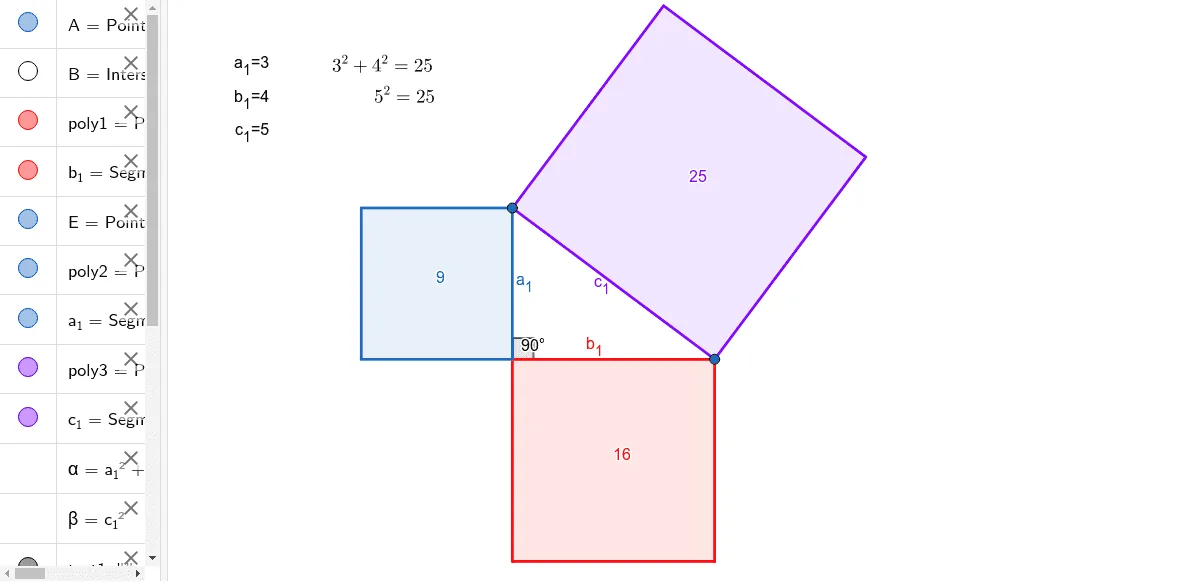
① This GeoGebra example demonstrates a dynamic, interactive proof of the Pythagorean theorem by constructing a right triangle and squares on each side, then comparing areas to show a² + b² = c². ② Core mathematical concepts include the Pythagorean theorem, right triangles, area of squares, geometric proof, and conservation of area. ③ Construction highlights: based on the summary, the example uses GeoGebra commands such as Point, Intersect, Polygon, and Angle, creating multiple points (A, B, C, D, E, F, G, H, I), polygons (poly1, poly2, poly3), segments (b_1, g, h, i, a_1, k, l, m, c_1, p, q, r), and angle labels (α, β, γ) along with several text objects (text1–text5) to display side lengths and area relationships. ④ Suitable for middle school to high school students learning geometric proofs, and for teachers demonstrating the theorem in class, fostering logical reasoning and dynamic geometry manipulation skills.
GeoGebra Commands & Parameters
Point(xAxis) → AIntersect(xAxis, yAxis) → BPolygon(A, B, 4) → poly1, b_1, g, h, i, C, DPoint(yAxis) → EPolygon(B, E, 4) → poly2, a_1, k, l, m, F, GPolygon(E, A, 4) → poly3, c_1, p, q, r, H, IAngle(E, B, A) → γ
AI Drawing Prompt Reference
Draw a coordinate plane with two perpendicular axes intersecting at a point. Place one point on the horizontal axis and another on the vertical axis, then connect these two points and the intersection to form a right triangle. Construct three squares outward on each side of the triangle: one on the horizontal leg, one on the vertical leg, and one on the hypotenuse. Inside each square, indicate area relationships with dashed auxiliary lines. Label the three angles of the triangle, marking the right angle. Add text near the figure showing that the sum of the squares of the two legs equals the square of the hypotenuse.
The prompt above was compiled from the original drawing commands and is for reference only.