
Can Four Pieces Fit into a Square?
Loading the math board and drawing, please wait…
In collections
Surface Area
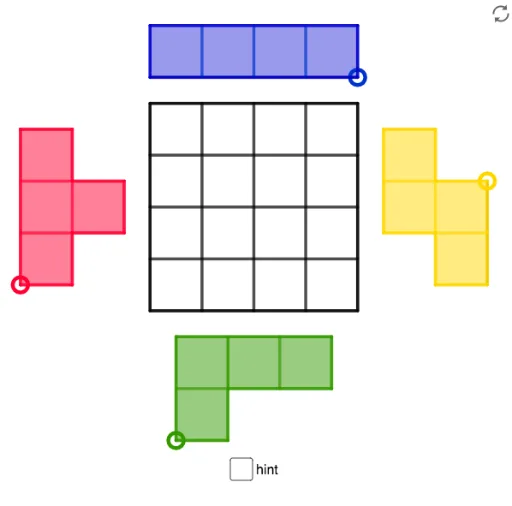
Explore whether four pieces can fit into a square and analyze the reasons. This example involves geometric transformations, particularly translation. Using GeoGebra commands such as Intersect, Polygon, and Midpoint, the movement of the pieces can be visually demonstrated. Suitable for middle school and above students to learn about geometric transformations and spatial imagination.
GeoGebra Commands & Parameters
Intersect(xAxis, yAxis) → APolygon(A, B, 4) → poly1, f, g, h, i, C, DMidpoint(D, A) → EMidpoint(A, B) → FMidpoint(B, C) → GMidpoint(C, D) → HMidpoint(H, D) → IMidpoint(D, E) → JMidpoint(E, A) → KMidpoint(A, F) → LMidpoint(F, B) → MMidpoint(B, G) → NMidpoint(G, C) → OMidpoint(C, H) → PSegment(I, L) → jSegment(H, F) → kSegment(P, M) → lSegment(J, O) → mSegment(E, G) → nSegment(K, N) → pPolygon(A, L, 4) → poly2, q, r, s, t, Q, RPolygon(F, M, 4) → poly3, a, b, c, d, S, TPolygon(Q, T, 4) → poly4, e, f_1, g_1, h_1, U, VPolygon(E, V, 4) → poly5, i_1, j_1, k_1, l_1, W, ZPolygon(I, W, 4) → poly6, m_1, n_1, p_1, q_1, A_1, B_1Polygon(A_1, U, 4) → poly7, r_1, s_1, t_1, a_1, C_1, D_1Polygon(C_1, S, 4) → poly8, b_1, c_1, d_1, e_1, E_1, F_1Polygon(P, D_1, 4) → poly9, f_2, g_2, h_2, i_2, G_1, H_1Point(Circle[I_1, 2]) → J_1Segment(I_1, J_1) → j_2Midpoint(j_2) → K_1Polygon(I_1, K_1, 4) → whiteS2, k_2, l_2, m_2, n_2, L_1, M_1Polygon(K_1, J_1, 4) → poly11, p_2, q_2, r_2, s_2, N_1, O_1Polygon(L_1, N_1, 4) → whiteS1, t_2, a_2, b_2, c_2, P_1, Q_1Polygon(P_1, N_1, 4) → poly13, d_2, e_2, f_3, g_3, R_1, S_1Polygon(I_1, J_1, N_1, R_1, S_1, Q_1, L_1, M_1) → Sborder_0, i_3, j_3, n_3, r_3, s_3, q_3, l_3, m_3Polygon(M_1, I_1, J_1, N_1, R_1, S_1, Q_1, L_1) → Sborder_2, m_4, i_4, j_4, n_4, r_4, s_4, q_4, l_4Segment(L_1, K_1) → h_3Segment(P_1, N_1) → k_3Segment(L_1, N_1) → p_3Point(Circle[T_1, 2]) → U_1Segment(T_1, U_1) → t_3Midpoint(t_3) → V_1Polygon(T_1, V_1, 4) → poly10, a_3, b_3, c_3, d_3, W_1, Z_1Polygon(V_1, U_1, 4) → whiteL1, e_3, f_4, g_4, h_4, A_2, B_2Polygon(Z_1, W_1, 4) → whiteL2, k_4, p_4, t_4, a_4, C_2, D_2Polygon(D_2, C_2, 4) → poly15, b_4, c_4, d_4, e_4, E_2, F_2Polygon(F_2, T_1, U_1, A_2, W_1, E_2) → Lborder_0, f_5, t_5, u_1, a_5, w_1, e_5Segment(D_2, C_2) → g_5Segment(Z_1, W_1) → h_5Segment(W_1, V_1) → i_5Polygon(F_2, T_1, U_1, A_2, W_1, E_2) → Lborder_2, f_6, t_6, u_2, a_6, w_2, e_6Point(Circle[G_2, 3]) → H_2Segment(G_2, H_2) → j_5Circle(G_2, 1) → c_5Circle(H_2, 1) → d_5Intersect(c_5, j_5, 1) → I_2Intersect(d_5, j_5, 1) → J_2Polygon(G_2, I_2, 4) → poly14, k_5, l_5, m_5, n_5, K_2, L_2Polygon(I_2, J_2, 4) → whiteT1, p_5, q_5, r_5, s_5, M_2, N_2Polygon(J_2, H_2, 4) → poly17, b_5, g_6, h_6, i_6, O_2, P_2Polygon(K_2, M_2, 4) → poly18, j_6, k_6, l_6, m_6, Q_2, R_2Polygon(G_2, H_2, O_2, M_2, Q_2, R_2, K_2, L_2) → Tborder_0, g_7, h_7, o_2, m_7, q_6, r_6, k_7, l_7Segment(K_2, I_2) → n_6Segment(K_2, M_2) → p_6Segment(M_2, J_2) → s_6Polygon(G_2, H_2, O_2, M_2, Q_2, R_2, K_2, L_2) → Tborder_2, g_8, h_8, o_1, m_8, q_7, r_7, k_8, l_8Point(Circle[S_2, 4]) → T_2Segment(S_2, T_2) → b_6Midpoint(b_6) → U_2Midpoint(S_2, U_2) → V_2Midpoint(U_2, T_2) → W_2Polygon(S_2, V_2, 4) → whiteI1, c_6, d_6, f_7, i_7, Z_2, A_3Polygon(V_2, U_2, 4) → poly19, j_7, n_7, p_7, s_7, B_3, C_3Polygon(U_2, W_2, 4) → whiteI2, t_7, a_7, b_7, c_7, D_3, E_3Polygon(W_2, T_2, 4) → Iborder_1, d_7, e_7, f_8, i_8, F_3, G_3Polygon(A_3, S_2, T_2, F_3) → Iborder_0, a_8, s_8, t_8, f_9Segment(Z_2, V_2) → j_8Segment(B_3, U_2) → n_8Segment(D_3, W_2) → p_8Polygon(A_3, S_2, T_2, F_3) → Iborder_2, a_9, s_9, t_9, f_{10}