
Calculating Surface Area of Rectangular Prism
Loading the math board and drawing, please wait…
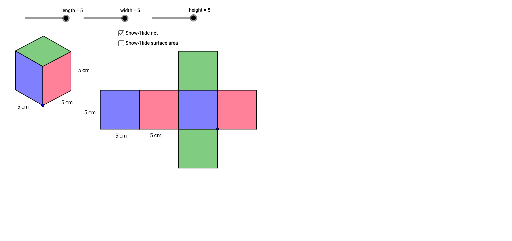
This example demonstrates how to dynamically calculate the surface area of a rectangular prism. It involves core math concepts like area calculation, geometric properties, and algebraic operations. GeoGebra commands and objects used include Vector, Translate, Polygon, Line, Intersect, and Midpoint. Suitable for middle school students and above for understanding 3D geometry calculations and parametric modeling, as well as for mathematical teaching demonstrations.
GeoGebra Commands & Parameters
Vector(A, B) → uVector(A, C) → vVector(A, D) → wTranslate(E, Vector[(height * u)]) → E'Vector(E, E') → zTranslate(E, Vector[(width * w)]) → E'_1Translate(E, Vector[(length * v)]) → E'_2Translate(E'_2, Vector[(height * u)]) → FTranslate(E'_1, Vector[(height * u)]) → GPolygon(F, E'_2, E, E') → poly1, f, e'_2, e, e'Polygon(E, E'_1, G, E') → poly2, e_1, e'_1, g, e'_3Line(F, g) → dLine(G, e') → hIntersect(d, h) → HPolygon(F, E', G, H) → poly3, f_1, e'_4, g_1, h_1Polygon(J, I, K, L) → poly4, j, i, k, lPolygon(N, J, I, M) → poly5, n, j_1, i_1, mPolygon(N, P, O, M) → poly6, n_1, p, o, m_1Polygon(Q, R, N, J) → poly7, q, r, n_2, j_2Polygon(T, S, I, M) → poly8, t, s, i_2, m_2Polygon(V, U, O, P) → poly9, v_1, u_1, o_1, p_1Midpoint(e'_2) → WMidpoint(e_1) → ZMidpoint(e'_1) → A_1Midpoint(v_1) → B_1Midpoint(u_1) → C_1Midpoint(o) → D_1Midpoint(m_2) → E_1Midpoint(t) → F_1
AI Drawing Prompt Reference
Draw a rectangular prism and dynamically calculate its surface area. Start by creating three perpendicular vectors representing the length, width, and height of the prism, then use translations of these vectors to construct the vertices and edges of the prism. Next, form the faces of the prism using polygon tools and calculate the area of each face. Finally, sum the areas of all faces to obtain the total surface area, highlighting the prism's faces and vectors with different colors or styles to illustrate geometric properties and parametric modeling.
The prompt above was compiled from the original drawing commands and is for reference only.