
Calculating Probability Using a Pinball Simulation
Loading the math board and drawing, please wait…
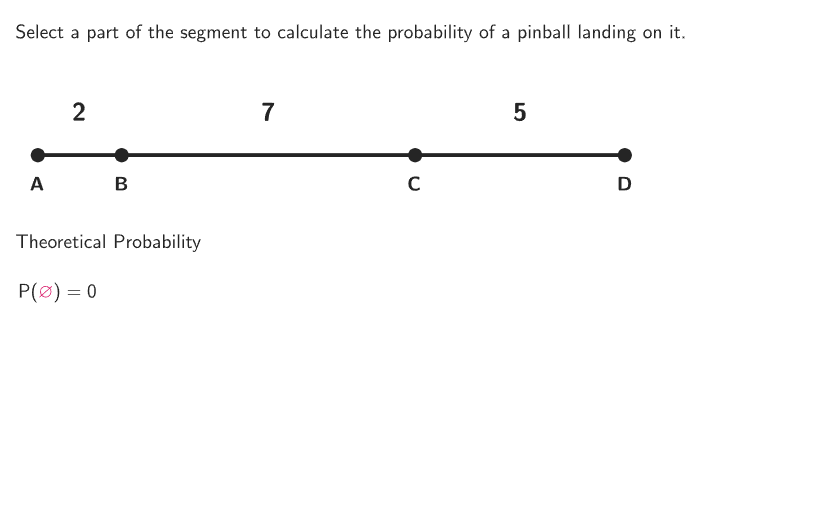
This example demonstrates probability by simulating a pinball's movement to compare theoretical and experimental probabilities. The key mathematical concept is geometric probability, where the ratio of areas is used. Construction involves GeoGebra commands like RandomUniform, Line, and Segment to create the path and regions. Suitable for grades 6-8 to explore probability in geometry.
GeoGebra Commands & Parameters
RandomUniform(0, 0.99, 200) → allRandomSeeds, {0.785694756253163, 0.9806807303442829, 0.4744696787349965, 0.07302956912855027, 0.6002911955890478, 0.41685885562467967, 0.6861535088471415, 0.047571139460948306, 0.3954983311529015, 0.7097217494407272, 0.24800847363370232, 0.2201887275198625, 0.8106600284811379, 0.5363199874340305, 0.5253245889388841, 0.5246633761588722, 0.2684459430993198, 0.15901160380693782, 0.8667465453496013, 0.8024028540295866, 0.5334640264145052, 0.9530060467445283, 0.45942020793128985, 0.8930432233486214, 0.356136941967206, 0.4730930985799898, 0.03231489525644536, 0.03427510264778363, 0.4900763763991845, 0.9214011190905512, 0.08245423274434464, 0.17263588028993462, 0.7944204085717418, 0.1524329391380891, 0.8462389362157464, 0.014383224618356555, 0.35177010880420334, 0.2494697045735961, 0.9864338778301837, 0.631374254747728, 0.6974681000705967, 0.7377123568218829, 0.5747174479578188, 0.48112456830770295, 0.9570073319406002, 0.05424704507426261, 0.8099557658651568, 0.16290525668751152, 0.5353403914783431, 0.09307487583335723, 0.5935644933956055, 0.7728600196182621, 0.8947799112038506, 0.4150390218217557, 0.7654605276350136, 0.9606849640006532, 0.1170374688490024, 0.8575103835551244, 0.8871813716352823, 0.4984111973212997, 0.38974418209889955, 0.8371607062709006, 0.04276399973916673, 0.36826662980233515, 0.2885278415926325, 0.5010557766321515, 0.14292612970015536, 0.5614657229443936, 0.9223915377994091, 0.7766436393187238, 0.23398160721307087, 0.3230869059872952, 0.8627466581400911, 0.9499913671869552, 0.9497473620563281, 0.4899454180414229, 0.15499719289750144, 0.6938415340248048, 0.6024636135148606, 0.778554525500967, 0.4160555752506634, 0.7527130928520013, 0.05744988634133021, 0.1488917247792147, 0.79158947294477, 0.39136377614034673, 0.9058579356164059, 0.15674630906194814, 0.8631568495785614, 0.3254599436486467, 0.33045925304250096, 0.30292347558341715, 0.7676815257567239, 0.5492667937899818, 0.02091809600380783, 0.39151523299042396, 0.16995335016046006, 0.5745764944987947, 0.09745238985940329, 0.7018214036667263, 0.7230079294747065, 0.7479326779873388, 0.6451733855073069, 0.5093150624508108, 0.37134718256829985, 0.18949021456121806, 0.9857213901295837, 0.5502940849936204, 0.6080081302378343, 0.38656497043081506, 0.8980781965514182, 0.562546500669413, 0.8884685570048507, 0.11808308075105671, 0.3366380779753214, 0.53048034522324, 0.09229904431357008, 0.2427311109017028, 0.4217582719680741, 0.35772915928134114, 0.8473277017273857, 0.22363729202771557, 0.8760857030800236, 0.8432422247225062, 0.8608791189671421, 0.6858814385828887, 0.3189702167493783, 0.4383044995215036, 0.688381476205186, 0.100034899476585, 0.2712261132311666, 0.871803822858032, 0.22130561896066775, 0.7252741879877513, 0.27339245307116583, 0.15937404203784403, 0.5340071534728592, 0.42939072833354924, 0.6724683813586252, 0.3787901810435957, 0.3425879566634997, 0.3402363811935522, 0.4048638553228518, 0.8091777811354688, 0.9483754907779045, 0.5237985471231233, 0.37700699179482017, 0.415221311845558, 0.27403857450203734, 0.8681902562229618, 0.8096880315685927, 0.19961732988815506, 0.09171531457403852, 0.8103702214868501, 0.28779633697338197, 0.3875157327770149, 0.5098242198587452, 0.453374757088205, 0.8936198643550596, 0.04562857702831169, 0.3284617168304894, 0.4562470481370943, 0.6693287220355588, 0.846058368672597, 0.6124591727811451, 0.6166920572648316, 0.8526518421024316, 0.18070859595805502, 0.966280140341301, 0.3777637072399701, 0.5790832850317251, 0.026387527950223585, 0.355983185473702, 0.654608531468472, 0.9742172734387733, 0.4334012401169554, 0.5804584868852238, 0.3454438000042206, 0.7210128162810492, 0.1415555289848067, 0.2470658340787871, 0.38254005161261584, 0.6189275100302891, 0.5470464674681815, 0.9456594890398617, 0.9240072991386645, 0.8149356411662082, 0.07171770402843557, 0.49977993107852225, 0.30565114721404335, 0.9704603956608897, 0.652597806210376, 0.8845254426202807, 0.44406888633110203, 0.6431999998667703, 0.8445045413039075, 0.7572856914476114, 0.4274978987478695, 0.048717295771883884, 0.10181277581867074}Take(allRandomSeeds, randIndex, randIndex + numRandoms - 1) → currentRandomSeedsRemoveUndefined(Zip[If[n, m], n, chosenSegs, m, boolPoss]) → boolSuccessIndexOf(true, boolSegs) → chosenIndLine((5.35, -1.9), (5.85, -1.85)) → guideLine2Angle(guideLine2, xAxis) → βSegment((5.35, -1.9), (5.85, -1.85)) → pinballBottomIntersect(pinballBottom, guideLine) → PullSeg1Intersect(y = -3, guideLine) → PullSeg2Segment(PullSeg1, PullSeg2) → pullSegNewPoint(pullSegNew) → PullPointAZip(Text[n, k - (lettWidth / 2, ((-lettHeight)) / 2 + 0.4) + sizeVect, true, true], n, {"A", "B", "C", "D"}, k, Points) → pointLabelsSegment((5.6, -2.14), (5.6, -3)) → pullSegSum(Zip[If[n, m, 0], n, chosenSegs, m, numSegs]) → topPolygon(Zip[PixelsToPoint[Corner[1], Corner[3], Corner[5], A], A, {(pixelsLeft, pixelsTop), (pixelsLeft, y(Corner[5]) - pixelsBottom), Corner[5] - (pixelsRight, pixelsBottom), (x(Corner[5]) - pixelsRight, pixelsTop)}]) → borderBoxCorner(5) → layoutAppSizeSegment((-4, 0), (4, 0)) → segmentStartSequence(Midpoint[Points(n), Points(n + 1)], n, 1, 3) → MidSegsFirst(textSteps, If[step ≟ 1, 1, step - 1]) → textCurrentStepsZip(Text[n, k - (numWidth / 2, -0.85) - numVect, true, true], n, {randomNum2, randomNum1 - (randomNum2 + randomNum3), randomNum3}, k, MidSegs) → textSegsFlatten({Sequence[Midpoint[MidSegs(n), MidSegs(n + 1)], n, 1, 2], (4.8, 0)}) → SignMidsZip(Text[n, k - (numWidth / 2, -0.85) - numVect, true, true], n, {"+", "+", "=\hspace{0.5cm}" + randomNum1}, k, SignMids) → textPlusStep2Segment(Points(numSegUse1), Points(numSegUse1 + 2)) → segmentProbCurveCartesian((0.25 * sin(t)) + 5.6, (-0.25 * ((curvFunct(yDiff) * t / ((pi * 6))) + cos(t) + 7.55)), t, 0, ((2 * pi) * 6)) → curAngle((0, 0), Intersect[guideLine, xAxis], PullSeg1) → αRotate(cur, (-(pi / 2 - α))) → cur'Translate(cur', (-0.23, -0.6)) → cur''Rotate(Polygon[{PullPointA + (0, 1 / ((2 * sqrt(3)))), PullPointA + (-1 / 4, -1 / ((4 * sqrt(3)))), PullPointA + (1 / 4, -1 / ((4 * sqrt(3))))}], (-β), PullPointA) → pullTriangleIntegralBetween(pinBallBTop, pinBallBottom, 4.2, 5.3) → shadingIntegralBetween(pinBallBTop, guideLine2, 5.3, 5.8) → shading2Line(PullSeg1, PullSeg2) → pullLineSegment(PointArrow1, PointArrow2) → arrowSegSegment(Points(1), Points(2)) → segment1Segment(Points(2), Points(3)) → segment2Segment(Points(3), Points(4)) → segment3Zip(Text[n, k - (numWidth / 2, -0.85) - numVect, true, true], n, Zip[If[n, m, ""], n, chosenSegs, m, numSegs], k, MidSegs) → textSegs3If(Defined[chosenInd] ∧ Length[chosenSignMids(chosenInd)] > 0, Sequence["+", n, 1, Length[chosenSignMids(chosenInd)]], {}) → plusSeqZip(Text[n, k - (numWidth / 2, -0.85) - numVect, true, true], n, If[Length[plusSeq] > 0, Flatten[{plusSeq, "=\hspace{0.5cm}" + top}], {"=\hspace{0.5cm}" + top}], k, Flatten[{If[Defined[chosenInd], chosenSignMids(chosenInd), {}], Element[SignMids, 3]}]) → textPlusStep3
AI Drawing Prompt Reference
Draw a geometric simulation of a pinball's movement to compare theoretical and experimental probabilities. Start by drawing a horizontal line as the starting point, then draw a slanted line segment as the pinball path. Next, draw two vertical line segments as the starting and ending points of the pinball. Randomly select several points on the path to draw several line segments representing the pinball's movement. Calculate and label angles and segment lengths, and use shading to indicate probabilities in different areas. Finally, draw a triangle to indicate the direction of the pinball's movement and label the probabilities on the path.
The prompt above was compiled from the original drawing commands and is for reference only.