
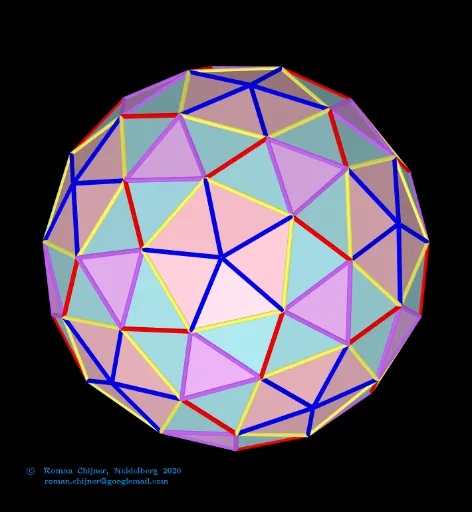
Biscribed Pentakis Snub Dodecahedron and Its Dual with Edge and Face Coloring
Loading the math board and drawing, please wait…
This example demonstrates the edge and face coloring of a biscribed pentakis snub dodecahedron and its dual. Key mathematical concepts include polyhedra, duals, edge and face coloring. GeoGebra commands such as Sequence, Sphere, Textfield are used in construction. Suitable for high school students or math enthusiasts.
GeoGebra Commands & Parameters
Sequence(((zoom * Element[Element[A00d, i], 1]), (zoom * Element[Element[A00d, i], 2]), (zoom * Element[Element[A00d, i], 3])), i, 1, Length[A00d]) → A0dSequence(((zoom * Element[Element[A00, i], 1]), (zoom * Element[Element[A00, i], 2]), (zoom * Element[Element[A00, i], 3])), i, 1, Length[A00]) → A0Sphere(O, r_o) → sp02dTextfield(R1sphere) → InputBox5Sphere(O, R1sphere) → sp01Textfield(r_o) → InputBox6Textfield(jarc) → InputBox8Textfield(jarc_d) → InputBox9Textfield(f_{Poly}) → InputBox11Textfield(k) → InputBox15Textfield(k_d) → InputBox14TableText({Append["i", 1…Length[mm5a]], Append["\fgcolor{orange}{n}", mm5a], Append["\fgcolor{orange}{N}", mm7a], Append["\fgcolor{#007FFF}{n/dual}", mm5ad], Append["\fgcolor{#007FFF}{N}", mm7ad]}, "hr") → text24Textfield(iseg) → InputBox17Textfield(f_{Poly}d) → InputBox18Textfield(isegd) → InputBox19UnicodeToLetter(34) → u34TableText({Append["i", 1…Max[Length[Segn], Length[Segnd]]], Append["\fgcolor{orange}{s_i}", Segn / Segments_o1], Append["\fgcolor{orange}{N}", lLength], Append["\fgcolor{#007FFF}{s_id}", Segnd / Segments_o1d], Append["\fgcolor{#007FFF}{N}", lLengthd]}, "hr") → text23Textfield(n_3) → InputBox20If(n_3 ≟ 0, "", Text["" + n_3]) → txt_3Textfield(nd_3) → InputBox21If(nd_3 ≟ 0, "", Text["" + nd_3]) → txtd_3Circle(A_{farbe}, rfabe) → farbekreisPointIn(farbekreis) → AAngle(A) → αSegment(C, D) → hSort(Sequence[Segment[Element[A0, Element[Element[nom, i], 1]], Element[A0, Element[Element[nom, i], 2]]], i, 1, Length[nom]]) → SegmentsFirst(Segments, i_s) → Segments_oKeepIf(round((x * 10^(k))) / 10^(k) ≟ Element[Segn, 1], Segments) → la1KeepIf(round((x * 10^(k))) / 10^(k) ≟ Element[Segn, 2], Segments) → la2KeepIf(round((x * 10^(k))) / 10^(k) ≟ Element[Segn, 3], Segments) → la3KeepIf(round((x * 10^(k))) / 10^(k) ≟ Element[Segn, 4], Segments) → la4Sequence(Polygon[Element[A0, Element[Element[mm1, f], 1]], Element[A0, Element[Element[mm1, f], 2]], Element[A0, Element[Element[mm1, f], 3]]], f, 1, Length[mm1]) → poly_{3}KeepIf(round((x * 10^(k))) / 10^(k) ≟ Element[poly_{3}S, 1], poly_{3}) → poly_{3}1KeepIf(round((x * 10^(k))) / 10^(k) ≟ Element[poly_{3}S, 2], poly_{3}) → poly_{3}2KeepIf(round((x * 10^(k))) / 10^(k) ≟ Element[poly_{3}S, 3], poly_{3}) → poly_{3}3Sort(Sequence[Segment[Element[A0d, Element[Element[nomd, i], 1]], Element[A0d, Element[Element[nomd, i], 2]]], i, 1, Length[nomd]]) → SegmentsdFirst(Segmentsd, id_s) → Segmentsd_oKeepIf(round((x * 10^(k))) / 10^(k) ≟ Element[Segnd, 1], Segmentsd) → lad1KeepIf(round((x * 10^(k))) / 10^(k) ≟ Element[Segnd, 2], Segmentsd) → lad2KeepIf(round((x * 10^(k))) / 10^(k) ≟ Element[Segnd, 3], Segmentsd) → lad3KeepIf(round((x * 10^(k))) / 10^(k) ≟ Element[Segnd, 4], Segmentsd) → lad4KeepIf(round((x * 10^(k))) / 10^(k) ≟ Element[Segnd, 5], Segmentsd) → lad5KeepIf(round((x * 10^(k))) / 10^(k) ≟ Element[Segnd, 6], Segmentsd) → lad6KeepIf(round((x * 10^(k))) / 10^(k) ≟ Element[Segnd, 7], Segmentsd) → lad7KeepIf(round((x * 10^(k))) / 10^(k) ≟ Element[Segnd, 8], Segmentsd) → lad8Sequence(Polygon[Element[A0d, Element[Element[mm1d, f], 1]], Element[A0d, Element[Element[mm1d, f], 2]], Element[A0d, Element[Element[mm1d, f], 3]]], f, 1, Length[mm1d]) → polyd_{3}KeepIf(round((x * 10^(k))) / 10^(k) ≟ Element[poly_{3}Sd, 1], polyd_{3}) → polyd_{3}1KeepIf(round((x * 10^(k))) / 10^(k) ≟ Element[poly_{3}Sd, 2], polyd_{3}) → polyd_{3}2KeepIf(round((x * 10^(k))) / 10^(k) ≟ Element[poly_{3}Sd, 3], polyd_{3}) → polyd_{3}3KeepIf(round((x * 10^(k))) / 10^(k) ≟ Element[poly_{3}Sd, 4], polyd_{3}) → polyd_{3}4Sequence(Polygon[Sequence[A0d(mm6d(1, f, k)), k, 1, Length[mm6d(1, 1)]]], f, 1, Length[mm6d(1)]) → polyd_{5}
AI Drawing Prompt Reference
Draw a biscribed pentakis snub dodecahedron and its dual, and color its edges and faces. The drawing includes color labels and text annotations. The construction order is to first draw the polyhedron, then color and annotate.
The prompt above was compiled from the original drawing commands and is for reference only.