
Billiard Trajectory on Trapezoidal Table
Loading the math board and drawing, please wait…
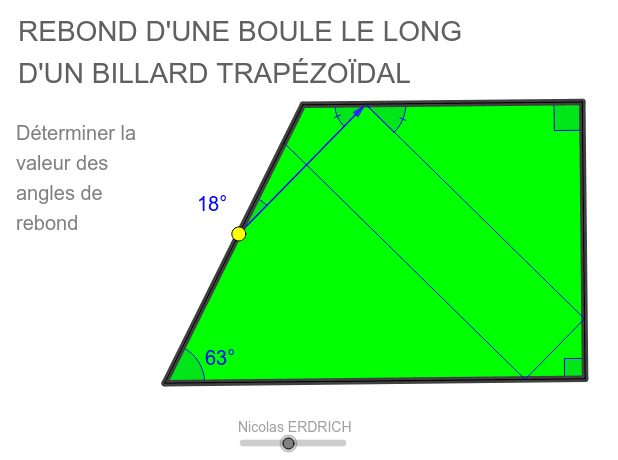
This example demonstrates the calculation and visualization of rebound angles on a trapezoidal billiard table. It involves core mathematical concepts such as angles, reflection laws, trigonometric functions, and vector operations. GeoGebra commands/objects used include Rotate, Line, Point, Segment, OrthogonalLine, Angle, Mirror, Intersect, Vector, and Polygon. Suitable for high school mathematics education to understand geometric transformations, reflection principles, and the application of trigonometric functions.
GeoGebra Commands & Parameters
Rotate(B, -o - 90°, A) → C'Line(A, C') → k_2Point(k_2) → DSegment(A, B) → a_1Segment(A, C_1) → b_1Line(C_1, a_1) → aOrthogonalLine(B, a) → bPoint(b_1) → D_1Point(a_1) → ESegment(D_1, E) → eAngle(A, E, D_1) → αOrthogonalLine(E, a_1) → fMirror(D_1, f) → D'Angle(D', E, B) → βLine(E, D') → gIntersect(a, b) → CSegment(B, C) → hSegment(C, C_1) → jLine(E, D') → iLine(A, B) → cLine(A, C_1) → dLine(E, D') → kIntersect(k, h) → HIntersect(k, j) → FSegment(E, H) → lSegment(E, F) → mOrthogonalLine(H, h) → nMirror(E, n) → E'Mirror(H, n) → H'Segment(E', H') → l'Line(H, E') → pIntersect(p, j) → IIntersect(p, b_1) → JSegment(J, H) → qSegment(I, H) → rOrthogonalLine(F, j) → sMirror(E, s) → E'_1Mirror(F, s) → F'Segment(E'_1, F') → m'Line(F, E'_1) → tIntersect(t, h) → KSegment(F, K) → c_1OrthogonalLine(K, h) → d_1Mirror(F, d_1) → F'_1Mirror(K, d_1) → K'Segment(F'_1, K') → e_1Line(K, F'_1) → f_1Intersect(f_1, a_1) → LSegment(K, L) → g_1OrthogonalLine(I, j) → h_1Mirror(I, h_1) → I'Mirror(H, h_1) → H'_1Segment(I', H'_1) → r'Line(I, H'_1) → i_1Intersect(i_1, b_1) → MSegment(I, M) → j_1OrthogonalLine(L, a_1) → k_1Mirror(K, k_1) → K'_1Mirror(L, k_1) → L'Segment(K'_1, L') → l_1Line(L, K'_1) → m_1Intersect(m_1, j) → NOrthogonalLine(N, j) → n_1Mirror(m_1, n_1) → p_1Intersect(p_1, b_1) → OSegment(L, N) → q_1Segment(N, O) → r_1OrthogonalLine(I, j) → s_1Mirror(I, s_1) → I'_1Mirror(H, s_1) → H'_2Segment(I'_1, H'_2) → r'_1Line(I, H'_2) → t_1Intersect(t_1, a_1) → PSegment(P, I) → a_2OrthogonalLine(P, a_1) → b_2Mirror(P, b_2) → P'Mirror(I, b_2) → I'_2Segment(P', I'_2) → c_2Line(P, I'_2) → d_2Intersect(d_2, b_1) → QSegment(P, Q) → e_2OrthogonalLine(L, a_1) → f_2Mirror(K, f_2) → K'_2Mirror(L, f_2) → L'_1Segment(K'_2, L'_1) → g_2Line(L, K'_2) → h_2Intersect(h_2, b_1) → RSegment(L, R) → i_2Segment(A, C') → j_2Angle(H, C, I) → δAngle(A, B, C) → εAngle(C, I, H) → ζAngle(M, I, D) → ηAngle(E, D_1, A) → θOrthogonalLine(F', j) → l_2Mirror(E, l_2) → E'_2Mirror(F, l_2) → F'_2Segment(E'_2, F'_2) → m'_1Line(F', E'_2) → m_2Intersect(m_2, a_1) → GSegment(G, F') → n_2OrthogonalLine(G, a_1) → p_2Mirror(G, p_2) → G'Mirror(F', p_2) → F''Segment(G', F'') → q_2Line(F'', G) → r_2Intersect(r_2, h) → SSegment(G, S) → s_2OrthogonalLine(S, h) → t_2Mirror(G, t_2) → G'_1Mirror(S, t_2) → S'Segment(G'_1, S') → a_3Line(S, G'_1) → b_3Intersect(j, b_3) → TSegment(S, T) → c_3OrthogonalLine(T, j) → d_3Mirror(S, d_3) → S'_1Mirror(T, d_3) → T'Segment(S'_1, T') → e_3Line(T, S'_1) → f_3Intersect(f_3, a_1) → USegment(U, T) → g_3OrthogonalLine(U, a_1) → h_3Mirror(U, h_3) → U'Mirror(T, h_3) → T'_1Segment(U', T'_1) → i_3Line(U, T'_1) → j_3Intersect(j_3, j) → VOrthogonalLine(V, j) → k_3Mirror(j_3, k_3) → l_3Intersect(l_3, b_1) → WSegment(W, V) → m_3Segment(V, U) → n_3OrthogonalLine(V, j) → p_3Mirror(V, p_3) → V'Mirror(U, p_3) → U'_1Segment(V', U'_1) → q_3Line(V, U'_1) → r_3Intersect(r_3, b_1) → ZSegment(Z, V) → s_3OrthogonalLine(N, j) → t_3Mirror(L, t_3) → L'_2Mirror(N, t_3) → N'Segment(L'_2, N') → a_4Line(N, L'_2) → b_4Intersect(b_4, a_1) → A_1OrthogonalLine(A_1, a_1) → c_4Segment(A_1, N) → d_4Mirror(A_1, c_4) → B_1Mirror(N, c_4) → N'_1Segment(B_1, N'_1) → e_4Line(N'_1, A_1) → f_4Intersect(f_4, b_1) → E_1Segment(A_1, E_1) → g_4OrthogonalLine(U, a_1) → h_4Mirror(U, h_4) → U'_2Mirror(T, h_4) → T'_2Segment(U'_2, T'_2) → i_4Line(U, T'_2) → j_4Intersect(j_4, b_1) → F_1Segment(U, F_1) → k_4OrthogonalLine(V, j) → l_4Mirror(V, l_4) → V'_1Mirror(U, l_4) → U'_3Segment(V'_1, U'_3) → m_4Line(U'_3, V) → n_4Intersect(n_4, a_1) → G_1OrthogonalLine(G_1, a_1) → p_4Mirror(n_4, p_4) → q_4Intersect(q_4, b_1) → H_1Segment(H_1, G_1) → r_4Segment(G_1, V) → s_4OrthogonalLine(G, a_1) → t_4Mirror(G, t_4) → G'_2Mirror(F', t_4) → F''_1Segment(G'_2, F''_1) → a_5Line(G, F''_1) → b_5Intersect(b_5, j) → I_1OrthogonalLine(I_1, j) → c_5Mirror(b_5, c_5) → d_5Intersect(d_5, h) → J_1OrthogonalLine(J_1, h) → e_5Mirror(d_5, e_5) → f_5Intersect(f_5, a_1) → K_1OrthogonalLine(K_1, a_1) → g_5Mirror(f_5, g_5) → h_5Intersect(h_5, j) → L_1OrthogonalLine(L_1, j) → i_5Segment(G, I_1) → j_5Segment(I_1, J_1) → k_5Segment(J_1, K_1) → l_5Segment(K_1, L_1) → m_5Mirror(h_5, i_5) → n_5Intersect(n_5, a_1) → M_1OrthogonalLine(M_1, a_1) → p_5Mirror(n_5, p_5) → q_5Intersect(q_5, j) → N_1OrthogonalLine(N_1, j) → r_5Mirror(q_5, r_5) → s_5Intersect(s_5, b_1) → O_1Segment(O_1, N_1) → t_5Segment(N_1, M_1) → a_6Segment(M_1, L_1) → b_6Angle(C, D, A) → ιVector(D_1, E) → uPolygon(A, B, C, D) → poly1, a_7, b_7, c_6, d_6
AI Drawing Prompt Reference
Draw a trapezoidal billiard table with a horizontal bottom edge. From the top-left vertex, draw a ray down to the bottom edge, marking the initial path. Choose a point on the bottom edge as the impact point, and draw a segment from this point into the table representing the ball's direction. At the impact point, construct a perpendicular line to the bottom edge, then reflect the incoming segment across this perpendicular to get the outgoing path. Extend this reflected path until it hits another side of the table, then again construct a perpendicular at that intersection and reflect the path. Repeat this process on each side, creating a polyline trajectory that bounces around the table. Label the incident and reflected angles, and show the normal lines as dashed. The final figure illustrates the complete multi-bounce path of the ball on the trapezoidal table.
The prompt above was compiled from the original drawing commands and is for reference only.