
Battleship Game: Random Placement on Coordinate Plane with Functions
Loading the math board and drawing, please wait…
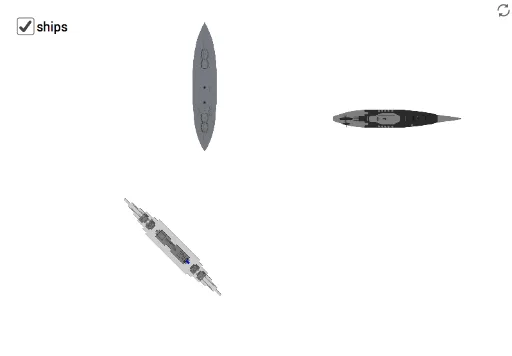
① This example presents a classic 'Battleship' game scenario on a coordinate plane, where ship-like shapes are randomly placed, combining visual elements from exponential functions and cones to demonstrate random experiments and coordinate positioning. ② Core mathematical concepts include the Cartesian coordinate system, point coordinates, random experiments, exponential function graphs, and plane figures (such as cone sections or projections). ③ Construction highlights: from the summary, multiple point objects (A, B, C, D, E, F), image objects (pic1, pic2, pic3), and a parameter 'a' are used, likely via sliders to control random positions or shape variations; GeoGebra commands for coordinate input, image insertion, and function plotting are employed to compose ship hulls and turrets from different shapes. ④ Suitable for middle and high school students, this serves as an engaging way to learn coordinate plotting, function graphs, and randomness, and can be used in math activity classes or introductory programming.
GeoGebra Commands & Parameters
Point A(-4, 2)Point B(0, 2)Point C(2, 5)Point D(2, 1)Point E(-3, 2)Point F(-6, -1)Boolean a(true)
AI Drawing Prompt Reference
Draw a battleship game scene on a coordinate plane, with several ships randomly placed. Mark key points at various coordinates, including some on the negative and positive axes and one higher up, to define ship outlines. Use exponential function curves for hulls and cone-like or triangular shapes for turrets, distributing them randomly. Include a toggle to control random placement or shape variation. The overall composition shows a coordinate grid, points, curves, and plane figures, suitable for teaching random experiments and coordinate positioning.
The prompt above was compiled from the original drawing commands and is for reference only.