
ASA Theorem for Triangle Congruence
Loading the math board and drawing, please wait…
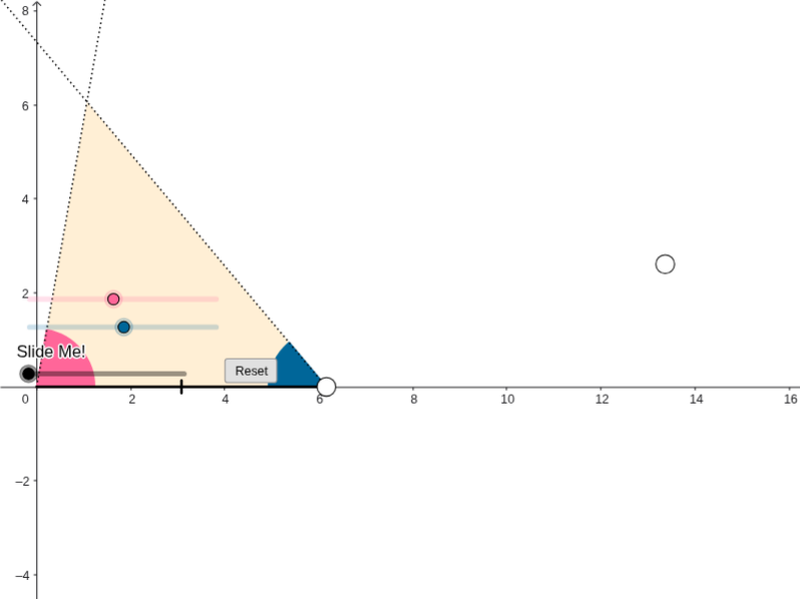
This example illustrates the ASA (Angle-Side-Angle) theorem for triangle congruence. The ASA theorem states that if two angles and the included side of one triangle are equal to two angles and the included side of another triangle, then the triangles are congruent. The dynamic illustration allows you to observe the transformation process of the triangles. The construction uses commands such as rotation, reflection, and translation. Suitable for middle school and above students to learn the proof methods of triangle congruence.
GeoGebra Commands & Parameters
Rotate(B, α, A) → B'Angle(B, A, B') → βRay(A, B') → fPoint(f) → CRotate(A, (-γ), B) → A'Angle(A', B, A) → δRay(B, A') → gIntersect(f, g) → DPolygon(A, B, D) → poly1, d, a_1, bSegment(A, B) → hSegment(D, B) → iSegment(D, A) → jMin({h, i, j}) → cCircle(A, (0.2 * c)) → eCircle(B, (0.2 * c)) → kIntersect(e, h) → E,Intersect(e, j) → F, IIntersect(k, h) → G,Intersect(k, i) → H, JCircleSector(A, E, F) → pCircleSector(B, H, G) → qRotate(K, β, L) → K'Angle(K, L, K') → εCircle(L, h) → rRay(L, K) → mIntersect(r, m, 1) → MRay(L, K') → nRotate(L, (-γ), M) → L'Angle(L', M, L) → ζRay(M, L') → sIntersect(n, s) → NDilate(A, If[0 < l ≤ 1, 1 - l, 0], L) → A'_1Vector(A, A'_1) → uTranslate(p, u) → p'Line(L, h) → tTranslate(F, u) → F'Point(t) → OAngle(M, L, O) → ηRotate(p', If[1 < l ≤ 2, ((-(l - 1)) * η), (-η)], L) → p''Point(t) → PAngle(P, L, M) → θDilate(B, If[2 < l ≤ 3, 3 - l, 0], L) → B'_1Vector(B, B'_1) → vTranslate(A, v) → A'_2Translate(B, v) → B'_2Segment(A'_2, B'_2) → h'Rotate(A'_2, If[3 < l ≤ 4, ((l - 3) * θ), θ], L) → QRotate(B'_2, If[3 < l ≤ 4, ((l - 3) * θ), θ], L) → RSegment(Q, R) → h''Dilate(B, If[4 < l ≤ 5, 5 - l, 0], M) → B'_3Vector(B, B'_3) → wTranslate(q, w) → q'Line(M, g) → f_1Point(f_1) → SAngle(N, M, S) → τRotate(q', If[5 < l ≤ 6, ((l - 5) * ((2 * π) - τ)), (2 * π) - τ], M) → q''Dilate(B, If[6 < l ≤ 7, 7 - l, 0], M) → B'_4Vector(B, B'_4) → u_1Translate(A, u_1) → A'_3Translate(B, u_1) → B'_5Translate(D, u_1) → D'Polygon(A'_3, B'_5, D') → poly1', d', a'_3, b'_5Rotate(A'_3, If[7 < l ≤ 8, ((-(l - 7)) * τ), (-τ)], M) → TRotate(B'_5, If[7 < l ≤ 8, ((-(l - 7)) * τ), (-τ)], M) → URotate(D', If[7 < l ≤ 8, ((-(l - 7)) * τ), (-τ)], M) → D''Polygon(T, U, D'') → poly1'', d'', t_1, u_2
AI Drawing Prompt Reference
Draw a triangle ABC with angle BAC and angle ABC and the included side AB congruent to triangle A'B'C'. First, rotate point B around point A to form angle B'. Then, draw a ray through point B' to find point C. Next, rotate point A around point B to form angle A'. Draw a ray through point A' to find point D. Connect points A, B, and D to form triangle ABD. Then, draw circles through points A and B to find points E, F, G, and H. Continue rotating, translating, and constructing arcs to eventually form triangle A'B'C', ensuring it is congruent to triangle ABC.
The prompt above was compiled from the original drawing commands and is for reference only.