
Area of Dilation
Loading the math board and drawing, please wait…
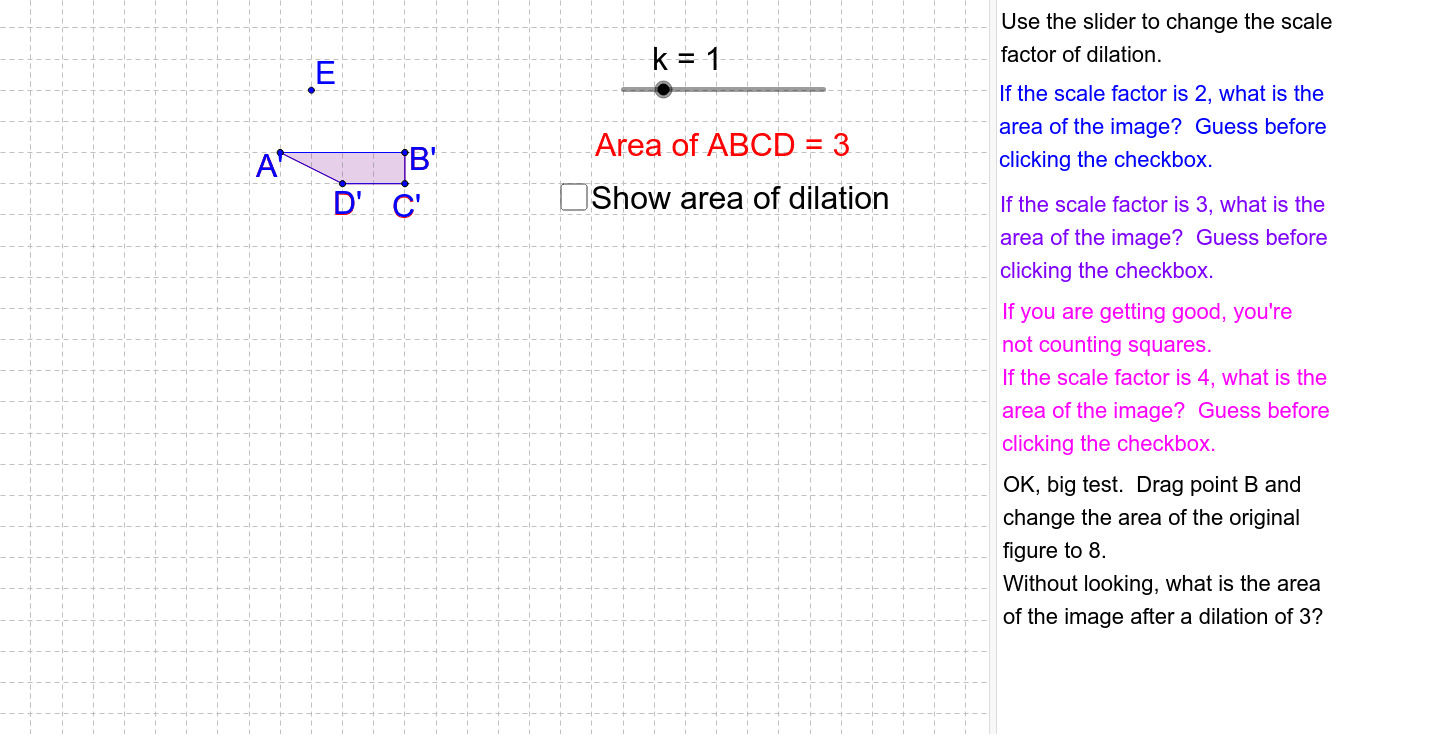
This example demonstrates the relationship between the scale factor of a dilation and the area of the transformed figure. Key math concepts include similarity, area ratio, and geometric transformations. It uses commands like Polygon, Dilate, PointIn, and Area to construct and analyze the dilation effect on polygonal areas, suitable for middle school and high school students learning transformation geometry.
GeoGebra Commands & Parameters
Polygon(A, B, C, D) → poly1, a, b, c, dDilate(A, k, E) → A'Dilate(B, k, E) → B'Dilate(C, k, E) → C'Dilate(D, k, E) → D'Polygon(A', B', C', D') → poly1', a', b', c', d'PointIn(poly1) → Pointpoly1PointIn(poly1') → Pointpoly1'Area(poly1) → fArea(A', B', C', D') → g
AI Drawing Prompt Reference
Draw a quadrilateral, then dilate it about an external point by a scale factor to create a second quadrilateral. Place a point inside each quadrilateral and compute the area of both shapes. The figure should clearly show the similarity between the original and dilated quadrilaterals, and illustrate how the area changes with the scale factor.
The prompt above was compiled from the original drawing commands and is for reference only.