
Area of a Parallelogram via Dissection into a Rectangle
Loading the math board and drawing, please wait…
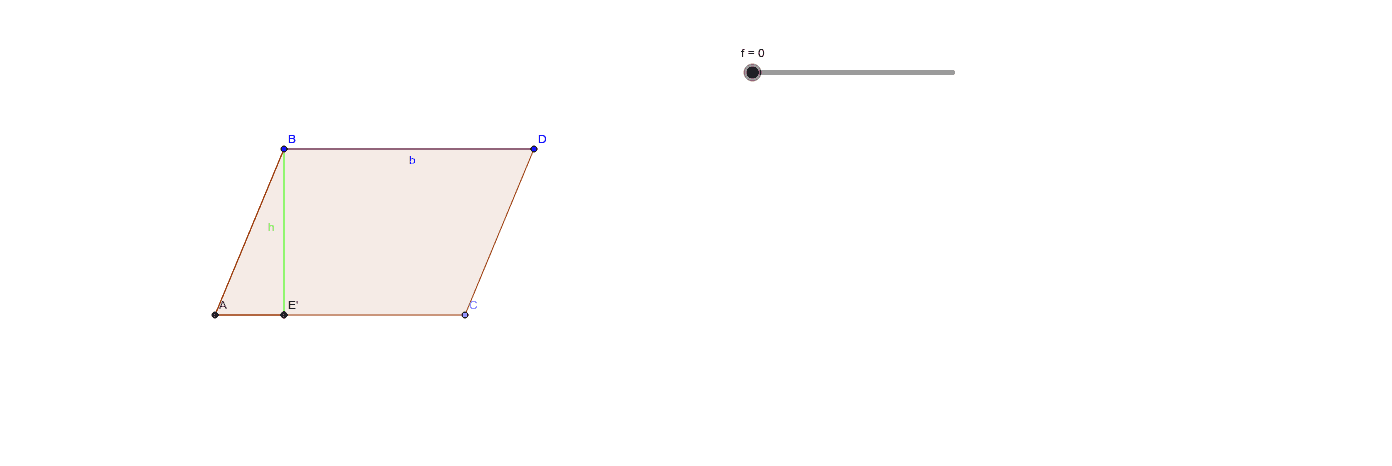
①This example demonstrates how to derive the area formula of a parallelogram by dissecting it along a height and translating the triangular piece to form a rectangle. ②Core mathematical concepts include the area formula (base × height), geometric transformation (translation), and the principle of area conservation under dissection. ③Construction details: Using GeoGebra commands such as Intersect, Point, Vector, Translate, OrthogonalLine, and Polygon, a parallelogram ABCD is built, and a triangular part is translated to reshape it into a rectangle, with dynamic visualization of the process. ④Suitable for middle school geometry classes or advanced elementary math, helping students understand the origin of the area formula and develop spatial reasoning and transformation thinking.
GeoGebra Commands & Parameters
Intersect(xAxis, yAxis) → APoint(xAxis) → CVector(A, C) → uTranslate(B, u) → DOrthogonalLine(B, xAxis) → aIntersect(a, xAxis) → EPolygon(A, B, E) → poly1, e, a_1, bPolygon(A, B, D, C) → poly2, a_2, b_1, d, cVector(A, F) → vTranslate(A, v) → A'Translate(B, v) → B'Translate(E, v) → E'Polygon(A', B', E') → poly1', e', a', b'Polygon(B, E, E', D) → poly3, b_2, e_1, e'_1, d_1
AI Drawing Prompt Reference
Draw a parallelogram, split it into a triangle along a height, and translate the triangle to form a rectangle, demonstrating the derivation of the parallelogram's area formula and emphasizing geometric transformation and area conservation.
The prompt above was compiled from the original drawing commands and is for reference only.