
Area of a Kite by Jeffrey P. Smith
Loading the math board and drawing, please wait…
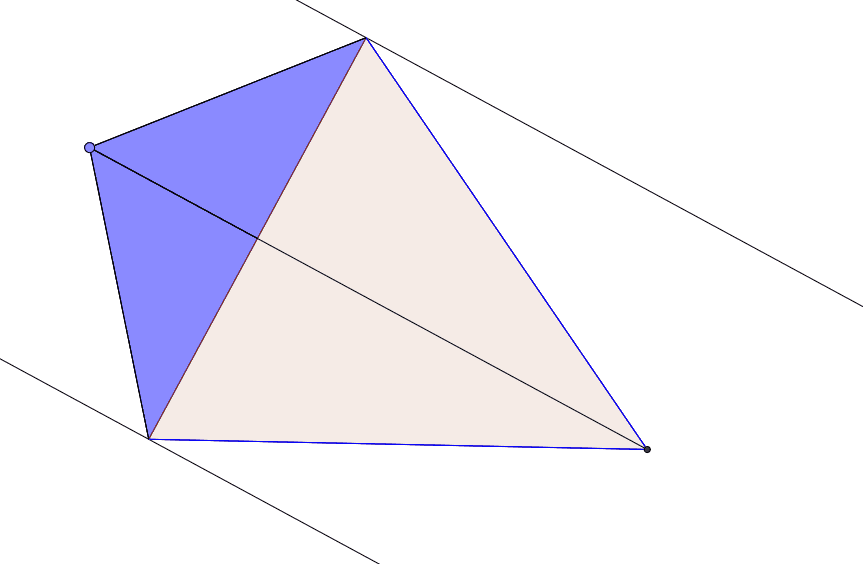
This example demonstrates how to calculate the area of a kite using geometric construction. Key mathematical concepts include the properties and area formula of a kite. Using GeoGebra commands such as Line, Point, Polygon, Segment, etc., a dynamic kite can be constructed and its area calculated.
GeoGebra Commands & Parameters
Line(A, B) → fPoint(f) → COrthogonalLine(C, f) → gCircle(C, D) → cIntersect(c, g, 1) → EIntersect(c, g, 2) → FPoint(f) → GPolygon(G, E, F) → poly1, f_1, g_1, ePoint(f) → HPolygon(F, H, E) → poly2, e_1, f_2, hSegment(C, G) → iDistance(C, G) → distanceCGPoint(Circle[C, 4]) → ISegment(C, I) → jCircle(H, Segment[G, I]) → dIntersect(d, f, 2) → JLine(E, f) → kLine(F, g_1) → lPolygon(H, E, J) → poly3, j_1, h_1, e_2Polygon(F, J, H) → poly4, h_2, f_3, j_2Segment(E, I) → mSegment(I, F) → nCircle(C, I) → pIntersect(p, f, 1) → KSegment(K, H) → qSegment(K, E) → rSegment(K, F) → sLine(F, q) → tIntersect(j, m) → LSegment(G, L) → aSegment(H, J) → b