
Area of a Fractal (1): Iterative Rotation and Scaling Exploration
Loading the math board and drawing, please wait…
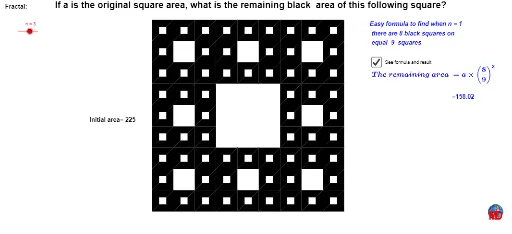
① This example demonstrates the construction of a fractal shape through iterative rotation and scaling operations, dynamically calculating its area to reveal how the area changes with iteration count. ② Core mathematical concepts include fractal geometry, area computation, similarity transformations (rotation and scaling), sequence iteration, and limit ideas, involving basic geometric objects such as polygons, ellipses, rectangles, and real-number parameters. ③ Construction highlights: Using GeoGebra commands Rotate, Dilate, Sequence, and Polygon, it creates points A, B, C, D, O and their transformed counterparts A', B', C', D', stores iteration results in lists list1 through list5, uses slider n to control iteration depth, and finally generates the fractal polygon poly1 with area text text1. ④ Suitable for high school and above, this serves as an introduction to fractal geometry, iteration and limits, and can be used in modeling or inquiry-based learning to help students understand self-similar shapes and area convergence phenomena.
GeoGebra Commands & Parameters
Rotate(A, -1.5708, B) → CRotate(B, 1.5707963267948966, A) → DDilate(A, 0.3333333333333333, O) → A'Dilate(B, 0.3333333333333333, O) → B'Dilate(C, 0.3333333333333333, O) → C'Dilate(D, 0.3333333333333333, O) → D'Sequence(Vector[O, Element[set, i]], i, 1, 8) → VecSequence(Translate[Dilate[list1, 0.3333333333333333, O], Vector[(2 / 3 * Element[Vec, i])]], i, 1, 8) → list2Sequence(Translate[Dilate[list2, 0.3333333333333333, O], Vector[(2 / 3 * Element[Vec, i])]], i, 1, 8) → list3Sequence(Translate[Dilate[list3, 0.3333333333333333, O], Vector[(2 / 3 * Element[Vec, i])]], i, 1, 8) → list4Sequence(Translate[Dilate[list4, 0.3333333333333333, O], Vector[(2 / 3 * Element[Vec, i])]], i, 1, 8) → list5Sequence(A + (i * Vector[A, B]), i, 0, 1, 0.3333333333333333) → liste1Sequence(D + (i * Vector[A, B]), i, 0, 1, 0.33333) → liste2Sequence(A + (i * Vector[A, D]), i, 0, 1, 0.33333) → liste3Sequence(B + (i * Vector[B, C]), i, 0, 1, 0.33333) → liste4Sequence(Segment[Element[liste1, i], Element[liste2, i]], i, 1, Length[liste1]) → liste5Sequence(Segment[Element[liste3, i], Element[liste4, i]], i, 1, Length[liste3]) → liste6Polygon(A, B, C, D) → poly1, a, b, c, d
AI Drawing Prompt Reference
Draw a fractal shape generated by iterative rotation and scaling of a square. Start with a square defined by four vertices. Rotate one vertex around an adjacent vertex by 90 degrees to create a new vertex, forming a new quadrilateral. Then scale the entire quadrilateral down to one-third of its size about its center, and translate copies in eight directions. Repeat this process multiple times, each time generating smaller quadrilaterals that stack to form a self-similar fractal pattern. Use a slider to control the number of iterations and display the current area of the fractal to observe how it changes with iteration count.
The prompt above was compiled from the original drawing commands and is for reference only.