
Area Model Fraction Multiplier by mathspace
Loading the math board and drawing, please wait…
In collections
Fractions and decimals
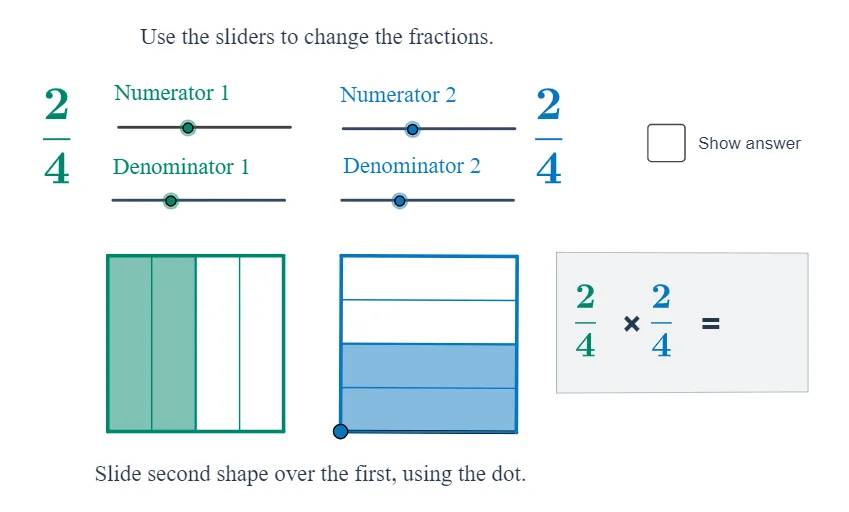
This example demonstrates the concept of fraction multiplication using an area model. It involves key mathematical concepts such as fractions and geometry. Using GeoGebra commands like Point, Polygon, Line, Segment, etc., users can visually understand the process of fraction multiplication. Suitable for high-grade elementary and junior high school students to learn fraction multiplication and geometric shapes.
GeoGebra Commands & Parameters
Point(Circle[A, 5]) → BPolygon(A, B, 4) → poly1, b, c, d, e, C, DLine(A, B) → fPoint(f) → ESegment(A, E) → gPoint(g) → FPoint(Circle[F, 5]) → GSegment(F, G) → hPolygon(F, G, 4) → poly2, i, j_1, k_1, l, H, IDilate(B, 1 / den_1, A) → B_1Sequence(Segment[Translate[D, Vector[(i * Vector[A, B_1])]], Translate[A, Vector[(i * Vector[A, B_1])]]], i, 1, den_1 - 1) → list1Dilate(H, 1 / den_2, G) → H_1Sequence(Segment[Translate[F, Vector[(i * Vector[G, H_1])]], Translate[G, Vector[(i * Vector[G, H_1])]]], i, 1, den_2 - 1) → list2Translate(A, Vector[(num_1 * Vector[A, B_1])]) → B_2Translate(B_2, Vector[A, D]) → C_2Translate(G, Vector[(num_2 * Vector[G, H_1])]) → H_2Translate(H_2, Vector[G, F]) → I_2Polygon(A, B_2, C_2, D) → poly3, a_1, b_2, c_2, d_1Polygon(F, G, H_2, I_2) → poly4, f_1, g_1, h_2, i_2Line(B_2, C_2) → jLine(I_2, H_2) → kIntersect(j, k) → SPolygon(A, B_2, S, I_2) → poly5, a_2, b_1, s, i_1If(Distance[A, F] < 0.01, true, false) → overSegment(J, K) → mPoint(Circle[N, 6.333215521509234]) → OPolygon(N, O, P, Q) → q1, n_1, o, p, qPolygon(R, T, U, V) → q2, r, t, u, v
AI Drawing Prompt Reference
Draw an area model to demonstrate fraction multiplication. Start by drawing a circle with center A and radius 5, and mark a point B on the circle. Then draw a square with diagonals A and B, and draw a line segment from A to B, marking point E on it. Draw another line segment from A to E, marking point F on it. Draw a circle with center F and radius 5, and mark a point G on the circle. Draw a line segment from F to G, and mark point H on it. Scale point B by a factor of 1/den_1 with A as the origin to get B_1, and draw a line segment from D to B_1, repeating this process den_1-1 times to get list1. Scale point H by a factor of 1/den_2 with G as the origin to get H_1, and draw a line segment from F to H_1, repeating this process den_2-1 times to get list2. Scale point A by a factor of num_1 with B_1 as the origin to get B_2, and then translate B_2 by vector[A, D] to get C_2. Scale point G by a factor of num_2 with H_1 as the origin to get H_2, and then translate H_2 by vector[G, F] to get I_2. Draw a quadrilateral with vertices A, B_2, C_2, and D, and another quadrilateral with vertices F, G, H_2, and I_2. Draw a line segment from B_2 to C_2, and another from I_2 to H_2, which intersect at point S. If the distance between A and F is less than 0.01, draw a line segment from J to K. Finally, draw a quadrilateral with vertices N, O, P, and Q, and another with vertices R, T, U, and V.
The prompt above was compiled from the original drawing commands and is for reference only.