
Area and Volume Ratio
Loading the math board and drawing, please wait…
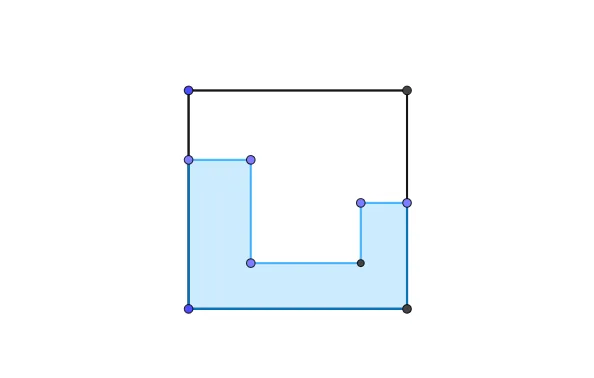
This example demonstrates the relationship between volume and area. By constructing geometric shapes, students can intuitively understand the concepts of area and volume. Core mathematical concepts include the calculation of geometric shapes' area and volume. GeoGebra commands used include Polygon, Point, Line, OrthogonalLine, and Intersect. Suitable for middle school and above students to learn geometry and solid geometry.
GeoGebra Commands & Parameters
Polygon(A, B, 4) → poly1, f, g, h, i, C, DPoint(f) → EPoint(h) → FLine(E, g) → jLine(F, g) → kPoint(j) → GOrthogonalLine(G, g) → lPoint(k) → HOrthogonalLine(H, g) → mPoint(l) → ILine(I, g) → nIntersect(m, n) → JPolygon(E, G, I, J, H, F, C, B) → poly2, e, g_1, i_1, j_1, h_1, f_1, c, b
AI Drawing Prompt Reference
First define two starting points A and B and construct an outer polygonal shape using A and B as key vertices (with the remaining vertices determined as in the outline). Select two relevant vertices on this outline and draw two lines that both pass through a common reference line: one line through the vertex corresponding to f and another through the vertex corresponding to h. Mark points where these lines meet the reference line, then from the two marked points draw perpendicular lines to the same reference line. Let the intersection of the two perpendicular lines be J. Finally, connect the points in the indicated cyclic order to form a composite polygon that includes the outer and inner vertices, emphasizing the region constrained by the reference line and the two perpendicular directions.
The prompt above was compiled from the original drawing commands and is for reference only.