
Arcs and Domes Construction
Loading the math board and drawing, please wait…
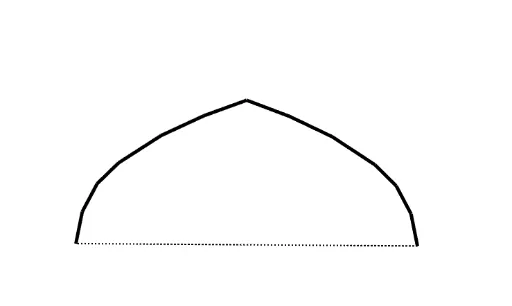
This example demonstrates the geometric construction of arcs and domes. It involves core mathematical concepts such as circles, triangles, polygons, and geometric transformations. Key GeoGebra commands and objects used in the construction include Intersect, Circle, Rotate, Mirror, Segment, Line, LineBisector, Sequence, Polygon, Point, Midpoint, Plane, and OrthogonalLine. It is suitable for high school students and teachers learning geometric constructions.
GeoGebra Commands & Parameters
Intersect(xAxis, yAxis) → AConstructionStep() → stapCircle(A, 4) → cIntersect(c, xAxis, 2) → BRotate(B, 90°) → CMirror(C, A) → DSegment(A, C) → fCircle(A, 1) → dIntersect(d, f, 1) → ECircle(A, 2) → eIntersect(e, f, 1) → FCircle(A, 3) → gIntersect(g, f, 1) → GCircle(A, 3.5) → hIntersect(h, f, 1) → HCircle(A, 3.85) → kIntersect(k, f, 1) → IMirror(K, zAxis) → K'Mirror(L, zAxis) → L'Mirror(M, zAxis) → M'Mirror(N, zAxis) → N'Mirror(O, zAxis) → O'Segment(J, K) → iSegment(K, L) → jSegment(L, M) → lSegment(M, N) → mSegment(N, O) → nSegment(O, C) → pSegment(J, K') → qSegment(K', L') → rSegment(L', M') → sSegment(M', N') → tSegment(N', O') → aSegment(O', D) → bLine(C, zAxis) → asRotate(O, 45°, as) → O'_1Rotate(N, 45°, as) → N'_1Rotate(M, 45°, as) → M'_1Rotate(L, 45°, as) → L'_1Rotate(K, 45°, as) → K'_1Rotate(J, 45°, as) → J'Rotate(K', 45°, as) → K''Rotate(L', 45°, as) → L''Rotate(M', 45°, as) → M''Rotate(N', 45°, as) → N''Rotate(O', 45°, as) → O''Rotate(D, 45°, as) → D'Segment(C, D) → m_{10}Segment(O'', D') → f_1Segment(O'', N'') → g_1Segment(N'', M'') → h_1Segment(M'', L'') → i_1Segment(L'', K'') → j_1Segment(K'', J') → k_1Segment(J', K'_1) → l_1Segment(K'_1, L'_1) → m_1Segment(L'_1, M'_1) → n_1Segment(M'_1, N'_1) → p_1Segment(N'_1, O'_1) → q_1Segment(C, O'_1) → r_1LineBisector(C, D', xOyPlane) → s_1LineBisector(C, D) → t_1Intersect(s_1, t_1) → PLine(P, zAxis) → rotasSequence(Rotate[l1, (nn * 90°), rotas], nn, 1, 7) → l2Sequence(Rotate[l3, (nn * 90°), rotas], nn, 1, 7) → l4Rotate(J, (360°) / 8, rotas) → J'_1Polygon(J, J'_1, 8, xOyPlane) → veelhoek1, a_1, R, S, T, U, V, b_1, c_1, d_1, e_1, f_2, g_2, h_2, QPoint(rotas) → WRotate(C, (360°) / 8, rotas) → C'Midpoint(C, C') → ZPlane(Z, P, P + (0, 0, 1)) → spiegMirror(L, spieg) → L'_2Mirror(M, spieg) → M'_2Mirror(N, spieg) → N'_2Mirror(O, spieg) → O'_2Intersect(j, spieg) → C_1Midpoint(L'_1, L) → A_1Midpoint(M'_1, M) → B_1Midpoint(N'_1, N) → D_1Plane(A_1, B_1, D_1) → p_2Midpoint(K'_1, K) → E_1Rotate(spieg, (360°) / 16, rotas) → spieg'Intersect(spieg', i) → F_1Mirror(K, spieg) → K'_2Mirror(F_1, spieg) → G_1Segment(P, C') → s_2Segment(P, C) → t_2OrthogonalLine(C, t_2, xOyPlane) → a_2OrthogonalLine(C', s_2, xOyPlane) → b_2Intersect(a_2, b_2) → H_1Line(O, a_2) → c_2Line(O'_2, b_2) → f_3Line(N, a_2) → g_3Line(N'_2, b_2) → h_3Line(M, a_2) → i_3Line(M'_2, b_2) → l_3Circle(rotas, V) → c_9Circle(rotas, G_1) → d_9Circle(rotas, K'_2) → e_9Circle(rotas, C_1) → p_9Circle(rotas, L) → q_9Circle(rotas, M) → r_9Circle(rotas, N) → s_9Circle(rotas, O) → t_9Circle(rotas, C) → c_{10}Rotate(H_1, (360°) / 8, rotas) → P_2Polygon(H_1, P_2, 8, xOyPlane) → veelhoek4, n_9, R_2, S_2, T_2, U_2, V_2, a_9, b_9, f_{10}, g_{10}, h_{10}, i_{10}, j_{10}, Q_2Sequence(Segment[Rotate[P, (nn * (360°) / 8), P], Rotate[C, (nn * (360°) / 8), P]], nn, 1, 7) → l15Segment(C, D) → k_{10}Rotate(D, 90°, P) → D'_1Segment(C, D'_1) → l_{10}Sequence(Segment[Rotate[C, (nn * 45°), P], Rotate[D, (nn * 45°), P]], nn, 1, 7) → l16Line(L, a_2) → m_3Line(L'_2, b_2) → n_3Intersect(c_2, f_3) → I_1Intersect(g_3, h_3) → J_1Intersect(i_3, l_3) → K_1Intersect(m_3, n_3) → L_1Polygon(C_1, L, L_1) → driehoek1, i_2, j_2, l_2Polygon(L, M, K_1, L_1) → vierhoek1, l_4, m_2, k_2, n_2Polygon(M, N, J_1, K_1) → vierhoek2, m_4, n_4, q_2, d_2Polygon(N, O, I_1, J_1) → vierhoek3, n_5, o, e_2, j_3Polygon(O, C, H_1, I_1) → vierhoek4, o_1, c_3, k_3, p_3Polygon(H_1, C', O'_2, I_1) → vierhoek5, q_3, c', o'_2, r_3Polygon(I_1, O'_2, N'_2, J_1) → vierhoek6, s_3, t_3, n'_2, a_3Polygon(J_1, N'_2, M'_2, K_1) → vierhoek7, b_3, d_3, m'_2, e_3Polygon(K_1, M'_2, L'_2, L_1) → vierhoek8, f_4, g_4, l'_2, h_4Polygon(L_1, L'_2, C_1) → driehoek2, i_4, j_4, k_4Segment(W, F_1) → q_4Segment(W, V) → r_4Segment(V, C_1) → s_4Rotate(b_2, (360°) / 8, zAxis) → t_4Mirror(L'_2, spieg') → M_1Mirror(M'_2, spieg') → N_1Mirror(N'_2, spieg') → O_1Mirror(O'_2, spieg') → P_1Mirror(C_1, spieg') → Q_1Line(C', rotas) → a_4Rotate(b_2, (360°) / 32, a_4) → b_4Polygon(F_1, C_1, Q_1) → driehoek3, c_4, d_4, e_4Polygon(C_1, L_1, M_1, Q_1) → vierhoek9, f_5, g_5, h_5, i_5Polygon(L'_2, M'_2, N_1, M_1) → vierhoek10, j_5, k_5, l_5, m_5Polygon(M'_2, N'_2, O_1, N_1) → vierhoek11, p_5, q_5, r_5, s_5Line(K'_2, a_2) → t_5Line(K, b_2) → a_5Intersect(t_5, a_5) → S_1Polygon(K'_2, C_1, S_1) → driehoek4, b_5, k'_2, c_5Polygon(G_1, K'_2, S_1, V) → vierhoek12, d_5, e_5, f_6, vPolygon(V, S_1, K, F_1) → vierhoek13, v_1, g_6, k_6, h_6Polygon(S_1, C_1, K) → driehoek5, k_7, i_6, j_6Segment(C', C) → l_6Line(H_1, l_6) → m_6Rotate(M, (360°) / 8, rotas) → M'_3Rotate(K_1, (360°) / 8, rotas) → R_1Segment(M'_3, R_1) → n_6Rotate(m_6, (360°) / 8, rotas) → p_6Line(C_1, m_6) → q_6Line(Q_1, p_6) → r_6Intersect(r_6, q_6) → T_1Line(L'_2, m_6) → s_6Line(M'_2, m_6) → t_6Line(N'_2, m_6) → a_6Line(O'_2, m_6) → b_6Plane(W, F_1, C') → p_7Intersect(s_6, p_7) → U_1Intersect(t_6, p_7) → V_1Intersect(a_6, p_7) → W_1Intersect(b_6, p_7) → Z_1Segment(F_1, T_1) → c_6Segment(T_1, U_1) → d_6Segment(U_1, V_1) → e_6Segment(V_1, W_1) → f_7Segment(O'_2, Z_1) → g_7Segment(Z_1, W_1) → h_7Segment(Z_1, C') → i_7Polygon(F_1, C_1, T_1) → driehoek6, j_7, l_7, m_7Polygon(C_1, L'_2, U_1, T_1) → vierhoek14, n_7, q_7, u_1, r_7Polygon(L'_2, M'_2, V_1, U_1) → vierhoek15, s_7, t_7, a_7, b_7Polygon(M'_2, N'_2, W_1, V_1) → vierhoek16, c_7, d_7, w_1, e_7Polygon(N'_2, O'_2, Z_1, W_1) → vierhoek17, f_8, g_8, z_1, h_8Polygon(Z_1, O'_2, C') → driehoek7, i_8, j_8, k_8Segment(B_2, C_2) → p_4Sequence(Rotate[l5, (nn * (360°) / 8), rotas], nn, 1, 7) → l6Mirror(l7, spieg') → l7'Sequence(Rotate[l7, (nn * (360°) / 8), rotas], nn, 1, 7) → l8Sequence(Rotate[l7', (nn * (360°) / 8), rotas], nn, 1, 7) → l9Sequence(Rotate[l10, (nn * (360°) / 8), rotas], nn, 1, 7) → l11Polygon(V, J, 8, xOyPlane) → veelhoek2, l_8, E_2, F_2, G_2, H_2, I_2, m_8, n_8, p_8, q_8, r_8, s_8, t_8, D_2Polygon(C_2, B_2, 8, xOyPlane) → veelhoek3, a_8, K_2, L_2, M_2, N_2, O_2, b_8, c_8, d_8, e_8, f_9, g_9, h_9, J_2Polygon(G_1, V, C_2) → driehoek8, i_9, j_9, v_2Polygon(V, F_1, B_2) → driehoek9, k_9, v_3, l_9Sequence(Rotate[driehoek8, (nn * (360°) / 8), rotas], nn, 1, 7) → l12Sequence(Rotate[driehoek9, (nn * (360°) / 8), rotas], nn, 1, 7) → l13Polygon(W, O_2, C_2) → driehoek10, m_9, w, o_2Sequence(Rotate[driehoek10, (nn * (360°) / 8), rotas], nn, 1, 7) → l14
AI Drawing Prompt Reference
Draw a geometric structure composed of multiple arcs and domes centered at the intersection of the x-axis and y-axis. Start with a circle of radius 4, then create several triangles and quadrilaterals through rotation and reflection, and finally connect the vertices of these polygons with line segments to form a complex geometric pattern.
The prompt above was compiled from the original drawing commands and is for reference only.