
Approximating the Volume of a Pyramid with Prisms
Loading the math board and drawing, please wait…
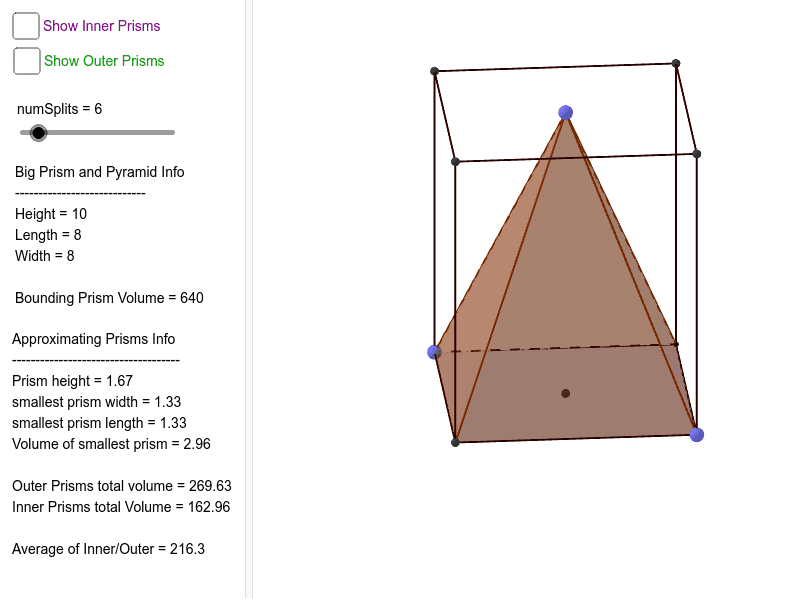
This example demonstrates how to approximate the volume of a pyramid using prisms. Key mathematical concepts include pyramids, prisms, and volume. Using GeoGebra commands such as Line, Polygon, Prism, etc., the base and sides of the pyramid are constructed, and prisms are used to approximate the pyramid's volume. Suitable for high school mathematics education and learning.
GeoGebra Commands & Parameters
Line(A, (1, 0, 0)) → aLine(A, (0, 1, 0)) → bLine(A, (0, 0, 1)) → cPoint(a) → BPoint(b) → CPolygon(A, B, D, C) → base, a_1, b_1, d, c_1Midpoint(A, D) → MLine(M, c) → ePoint(e) → EPyramid(base, E) → pyr, faceABE, faceBDE, faceCDE, faceACE, edgeAE, edgeBE, edgeDE, edgeCEDistance(M, E) → heightDistance(A, B) → widthDistance(A, C) → lengthSequence((length / numSplits * n), n, numSplits, 1, -1) → prismLengthsSequence((width / numSplits * n), n, numSplits, 1, -1) → prismWidthsSequence((prismHeight * n), n, 0, numSplits - 1) → prismHeightsSequence(M + Vector[(((-prismWidths(n))) / 2, ((-prismLengths(n))) / 2, prismHeights(n))], n, 1, numSplits) → PyramidCornersSequence(Polygon[PyramidCorners(n), PyramidCorners(n) + Vector[(prismWidths(n), 0, 0)], PyramidCorners(n) + Vector[(prismWidths(n), prismLengths(n), 0)], PyramidCorners(n) + Vector[(0, prismLengths(n), 0)]], n, 1, numSplits) → prismBasesSequence(Prism[prismBases(n), prismHeight], n, 1, numSplits) → OuterPrismsPrism(base, height) → BigPrism, F, edgeAF, edgeBG, edgeDH, edgeCI, edgeFG, edgeGH, edgeHI, edgeFI, G, H, I, faceABGF, faceBDHG, faceCDHI, faceACIF, faceFGHISum(OuterPrisms) → outerSumSequence(Prism[prismBases(n), (-prismHeight)], n, 2, numSplits) → InnerPrismsSum(InnerPrisms) → InnerVolumeMean({InnerVolume, outerSum}) → prismAverage
AI Drawing Prompt Reference
Draw a pyramid and approximate its volume using multiple prisms. Start by creating a pyramid with a quadrilateral base, then build multiple prisms from the base of the pyramid upwards, adjusting their heights and base sizes to closely match the pyramid. Finally, calculate the volume of all the prisms and find the average.
The prompt above was compiled from the original drawing commands and is for reference only.