
Application of Derivatives
Loading the math board and drawing, please wait…
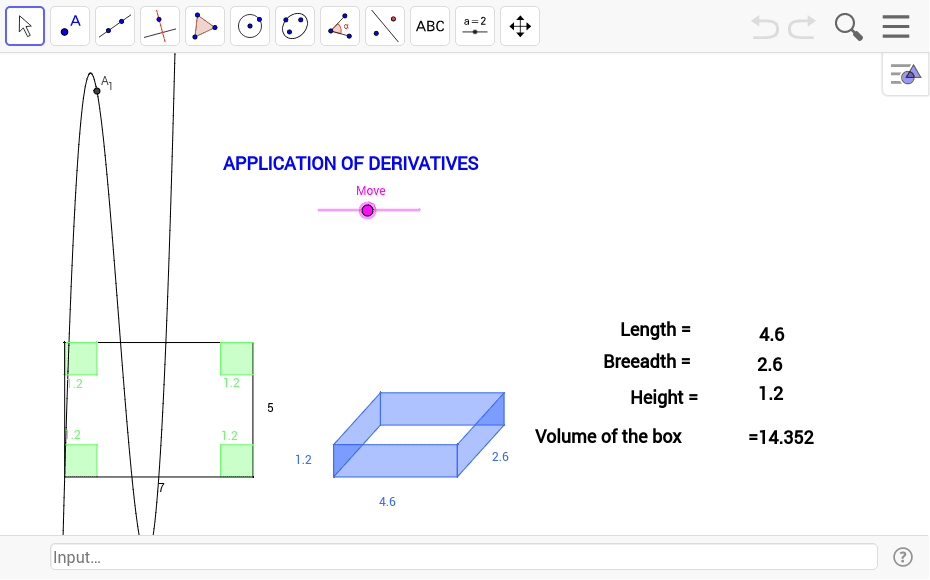
This example demonstrates how to use derivatives to determine the maximum and minimum values of functions, focusing on core concepts like derivatives and optimization. It constructs geometric models using commands such as Segment, Polygon, Circle, Point, Line, Intersect, OrthogonalLine, Distance, and Perimeter in GeoGebra, making it suitable for high school and above students learning real-world applications of function optimization.
GeoGebra Commands & Parameters
Segment(C, D) → a_1Segment(D, B) → bPolygon(G, F, E, A) → poly1, g, f, e, a_2Polygon(J, I, B, H) → poly2, j, i, b_1, hPolygon(P, N, D, O) → poly3, p, n, d, oPolygon(K, M, L, C) → poly4, k, m, l, cCircle(Q, 5 - 2 * a) → qPoint(q) → RLine(Q, R) → rLine(R, xAxis) → sLine(T, r) → tIntersect(s, t) → UOrthogonalLine(R, s) → c_1OrthogonalLine(T, xAxis) → d_1OrthogonalLine(Q, xAxis) → e_1OrthogonalLine(U, xAxis) → f_1Line(S, r) → g_1Intersect(g_1, c_1) → VLine(V, s) → h_1Line(S, xAxis) → i_1Intersect(i_1, d_1) → WLine(W, t) → j_1Intersect(j_1, f_1) → ZPolygon(S, Q, T, W) → poly5, s_1, q_1, t_1, wPolygon(V, R, U, Z) → poly6, v, r_1, u, zPolygon(T, U, Z, W) → poly7, t_2, u_1, z_1, w_1Polygon(S, Q, R, V) → poly8, s_2, q_2, r_2, v_1Distance(w, t_2) → k_1Perimeter(poly7) → l_1Segment(C, A) → m_1Segment(A, B) → n_1Perimeter(poly8) → o_1Distance(b, n_1) → p_1Distance(j, h) → b_2Distance(f, k) → c_2