
AP 2009AB Volume Problem Demonstration: Calculating Volume via Integration
Loading the math board and drawing, please wait…
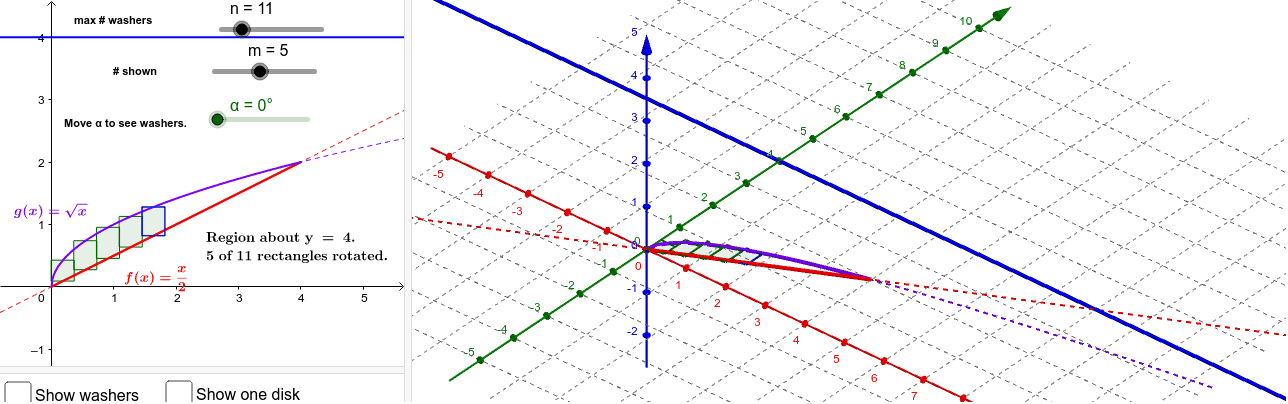
This example demonstrates how to calculate the volume of a geometric solid using integration, involving calculus concepts such as integration and volume of solids. The construction uses GeoGebra commands like Sequence, Polygon, Rotate, Integral, Surface to generate the 3D shape. Key steps include defining functions, rotating to create surfaces, and computing integrals. Suitable for high school students learning calculus fundamentals or for exercises combining geometry and calculus.
GeoGebra Commands & Parameters
Sequence(Polygon[((k * h), f(((k + p) * h))), (((k + 1) * h), f(((k + p) * h))), (((k + 1) * h), g(((k + p) * h))), ((k * h), g(((k + p) * h)))], k, 0, m - 1) → RectanglesPolygon(((DK * h), g(((DK + p) * h))), (((DK + 1) * h), g(((DK + p) * h))), (((DK + 1) * h), f(((DK + p) * h))), ((DK * h), f(((DK + p) * h)))) → Rectangle1, b, c, d, eRotate(Rectangle1, α, a) → Rectangle1'Integral((π * ((4 - f(x))^(2) - (4 - g(x))^(2))), 0, 4) → VolIntegRotate(f_1, α, a) → iRotate(g_1, α, a) → jSurface(((DK + 1) * h), 4 - ((4 - u) * cos(β)), ((4 - u) * sin(β)), u, f(((DK + p) * h)), g(((DK + p) * h)), β, 0, α) → SideRight1Surface((DK * h), 4 - ((4 - u) * cos(β)), ((4 - u) * sin(β)), u, f(((DK + p) * h)), g(((DK + p) * h)), β, 0, α) → SideLeft1Surface(u, 4 - ((4 - f(((DK + p) * h))) * cos(β)), ((4 - f(((DK + p) * h))) * sin(β)), u, (DK * h), ((DK + 1) * h), β, 0, α) → Outer1Surface(u, 4 - ((4 - g(((DK + p) * h))) * cos(β)), ((4 - g(((DK + p) * h))) * sin(β)), u, (DK * h), ((DK + 1) * h), β, 0, α) → Inner1Rotate(Rectangles, α, a) → Rectangles'Surface(u, 4 - ((4 - g(u)) * cos(β)), ((4 - g(u)) * sin(β)), u, 0, 4, β, 0, (2 * π)) → InnerSurface(u, 4 - ((4 - f(u)) * cos(β)), ((4 - f(u)) * sin(β)), u, 0, 4, β, 0, (2 * π)) → OuterSequence(Surface[u, 4 - ((4 - g(((k + p) * h))) * cos(β)), ((4 - g(((k + p) * h))) * sin(β)), u, (k * h), ((k + 1) * h), β, 0, α], k, 0, m - 1) → InnersSequence(Surface[u, 4 - ((4 - f(((k + p) * h))) * cos(β)), ((4 - f(((k + p) * h))) * sin(β)), u, (k * h), ((k + 1) * h), β, 0, α], k, 0, m - 1) → OutersSequence(Surface[(k * h), 4 - ((4 - u) * cos(β)), ((4 - u) * sin(β)), u, f(((k + p) * h)), g(((k + p) * h)), β, 0, α], k, 0, m - 1) → SidesLeftSequence(Surface[((k + 1) * h), 4 - ((4 - u) * cos(β)), ((4 - u) * sin(β)), u, f(((k + p) * h)), g(((k + p) * h)), β, 0, α], k, 0, m - 1) → SidesRightRectangleSum(A, 0, (m * h), m, p) → WS
AI Drawing Prompt Reference
Please draw a demonstration of calculating the volume of a geometric solid using integration. First, define two functions and use them to generate a sequence of rectangles. Rotate one of these rectangles around an axis to create surfaces. Then compute the integral to determine the volume. Finally, use rotation and surface commands to generate various parts of the 3D shape, including inner and outer surfaces and sides. These steps show how to combine geometry and calculus concepts to calculate volume.
The prompt above was compiled from the original drawing commands and is for reference only.