
AP 2007AB_1b Volume Problem Demo
Loading the math board and drawing, please wait…
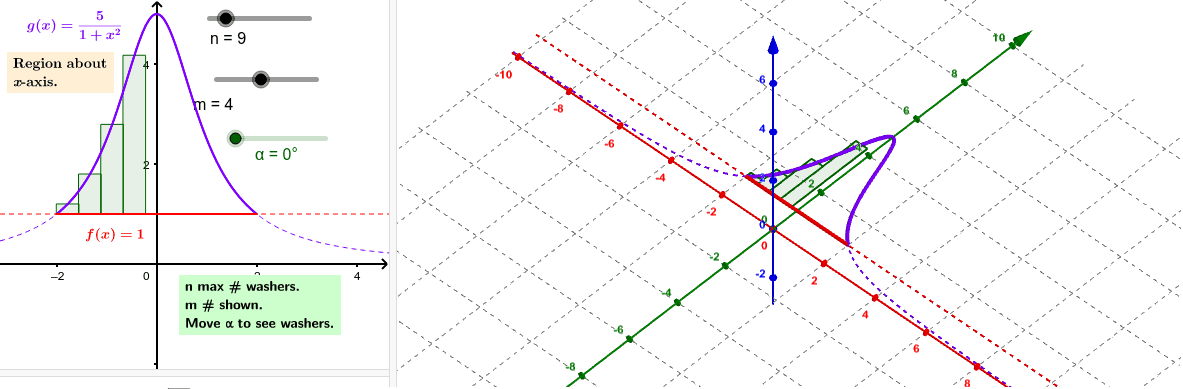
This example demonstrates how to calculate the volume of a solid of revolution using rotation and integration; core math concepts include solid of revolution volume, integral calculation, and geometric transformation; construction highlights from the summary utilize commands/objects like Sequence, Polygon, Rotate, Integral, RectangleSum, and Surface in GeoGebra; suitable for high school students learning calculus and solid geometry to understand volume calculation methods.
GeoGebra Commands & Parameters
Sequence(Polygon[(-2 + (k * h), f(-2 + ((k + p) * h))), (-2 + ((k + 1) * h), f(-2 + ((k + p) * h))), (-2 + ((k + 1) * h), g(-2 + ((k + p) * h))), (-2 + (k * h), g(-2 + ((k + p) * h)))], k, 0, m - 1) → RectanglesPolygon((-2 + (DK * h), f(-2 + ((DK + p) * h))), (-2 + ((DK + 1) * h), f(-2 + ((DK + p) * h))), (-2 + ((DK + 1) * h), g(-2 + ((DK + p) * h))), (-2 + (DK * h), g(-2 + ((DK + p) * h)))) → Rectangle1, b, c, d, eRotate(Rectangle1, α, xAxis) → Rectangle1'Integral(A, -2, 2) → VolIntegRectangleSum(A, -2, -2 + (m * h), m, p) → WSSurface(u, (f(u) * cos(β)), (f(u) * sin(β)), u, -2, 2, β, 0, (2 * π)) → InnerSurface(u, (g(u) * cos(β)), (g(u) * sin(β)), u, -2, 2, β, 0, (2 * π)) → OuterSurface(-2 + (DK * h), (u * cos(β)), (u * sin(β)), u, f(-2 + ((DK + p) * h)), g(-2 + ((DK + p) * h)), β, 0, α) → SideLeft1Surface(-2 + ((DK + 1) * h), (u * cos(β)), (u * sin(β)), u, f(-2 + ((DK + p) * h)), g(-2 + ((DK + p) * h)), β, 0, α) → SideRight1Surface(-2 + u, (f(-2 + ((DK + p) * h)) * cos(β)), (f(-2 + ((DK + p) * h)) * sin(β)), u, (DK * h), ((DK + 1) * h), β, 0, α) → Inner1Surface(-2 + u, (g(-2 + ((DK + p) * h)) * cos(β)), (g(-2 + ((DK + p) * h)) * sin(β)), u, (DK * h), ((DK + 1) * h), β, 0, α) → Outer1Rotate(g_1, α, xAxis) → iRotate(f_1, α, xAxis) → jRotate(Rectangles, α, xAxis) → Rectangles'Sequence(Surface[-2 + u, (f(-2 + ((k + p) * h)) * cos(β)), (f(-2 + ((k + p) * h)) * sin(β)), u, (k * h), ((k + 1) * h), β, 0, α], k, 0, m - 1) → InnersSequence(Surface[-2 + u, (g(-2 + ((k + p) * h)) * cos(β)), (g(-2 + ((k + p) * h)) * sin(β)), u, (k * h), ((k + 1) * h), β, 0, α], k, 0, m - 1) → OutersSequence(Surface[-2 + (k * h), (u * cos(β)), (u * sin(β)), u, f(-2 + ((k + p) * h)), g(-2 + ((k + p) * h)), β, 0, α], k, 0, m - 1) → SidesLeftSequence(Surface[-2 + ((k + 1) * h), (u * cos(β)), (u * sin(β)), u, f(-2 + ((k + p) * h)), g(-2 + ((k + p) * h)), β, 0, α], k, 0, m - 1) → SidesRight