
Another Popular Trig Identity: Geometric Illustration via Areas
Loading the math board and drawing, please wait…
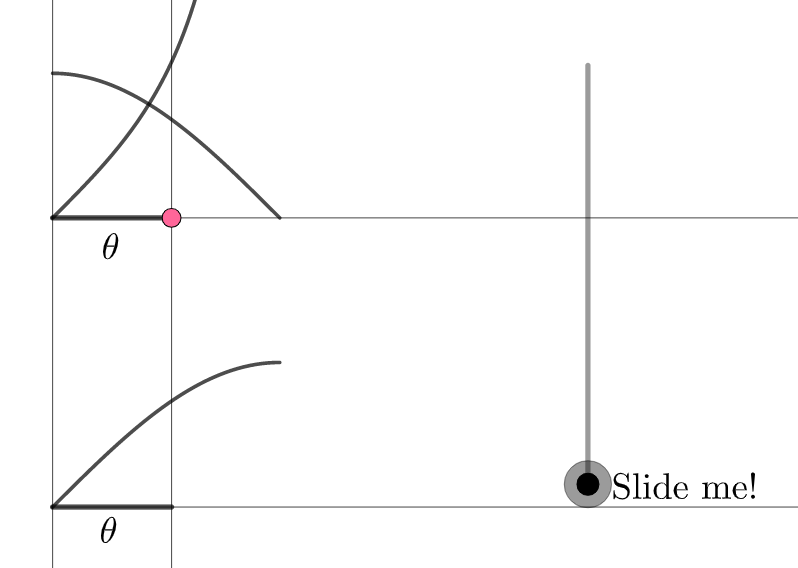
① This example demonstrates a popular trigonometric identity through a geometric area-based illustration, turning an algebraic identity into a visual equality of areas. ② Core mathematical concepts include trigonometric functions (sine, cosine, tangent), trigonometric identities, geometric area, and elements of function graphs, lines, and secants. ③ Construction highlights: Based on the construction summary, the example uses GeoGebra commands such as Point, Intersect, Polygon, Dilate, Segment, Vector, Translate, Rotate, Line, Ray, Circle, OrthogonalLine, and Angle, and creates numerous auxiliary objects (e.g., h, f, A, p, eq1, B, C, q, D, eq2, E, q1, a, e, d, c, b, g, F, G, H, I, q2, h_1, g_1, f_1, i, j, A', k, C', u, A'_1, A'', k', A'_2, l, B', m, D') to dynamically show that the areas on both sides of the identity are equal. ④ It is suitable for high school or early college students learning trigonometry, geometry, and introductory calculus, and also for teachers creating interactive lessons to help students grasp the geometric essence of trigonometric identities.
GeoGebra Commands & Parameters
Point(Segment[(0, 0), (π / 2, 0)]) → AIntersect(f, eq1, (0.8228536275037948, 0.6801320145437539)) → BIntersect(h, eq1, (0.8228536275037948, 1.0778637671534934)) → CIntersect(xAxis, eq2) → EPolygon(A, E, D, C) → q1, a, e, d, cIntersect(p, eq1, (0.8228536275037948, -1.2669103446421748)) → FIntersect(eq1, g) → GPolygon(H, G, F, I) → q2, h_1, g_1, f_1, iDilate(A, If[0 < j ≤ 1, 1 - j, 0], C) → A'Segment(A, A') → kDilate(C, If[2 < j ≤ 3, 3 - j, 0], D) → C'Vector(C, C') → uTranslate(A, u) → A'_{1}Translate(A', u) → A''Segment(A'_{1}, A'') → k'Dilate(A, If[3 < j ≤ 4, 4 - j, 0], B) → A'_{2}Segment(A, A'_{2}) → lRotate(B, If[5 < j ≤ 6, ((-(j - 5)) * π / 2), ((-π)) / 2], A) → B'Segment(A, B') → mDilate(D, If[6 < j ≤ 7, 7 - j, 0], C) → D'Vector(D, D') → vTranslate(A'_{1}, v) → JTranslate(A'', v) → A'''Segment(J, A''') → k''Dilate(A, If[7 < j ≤ 8, 8 - j, 0], C) → A'_{3}Vector(A, A'_{3}) → wTranslate(A, w) → A'_{4}Translate(B', w) → B''Segment(A'_{4}, B'') → m'Polygon(A, E, D, C) → q3, a_1, e_1, d_1, c_1Intersect(h, yAxis, (0, 0)) → KLine(A, C) → nRay(K, A) → rRay(M, G) → sDilate(G, If[9 < j ≤ 10, 10 - j, 0], F) → G'Segment(G, G') → tDilate(K, If[11 < j ≤ 12, 12 - j, 0], L) → K'Segment(K, K') → i_1Dilate(K, If[13 < j ≤ 14, 14 - j, 0], F) → K'_{1}Vector(K, K'_{1}) → u_1Translate(K, u_1) → K'_{2}Translate(K', u_1) → K''Segment(K'_{2}, K'') → j_1Rotate(K'_{2}, If[14 < j ≤ 15, ((-(j - 14)) * π / 2), ((-π)) / 2], F) → NRotate(K'', If[14 < j ≤ 15, ((-(j - 14)) * π / 2), ((-π)) / 2], F) → K'''Segment(N, K''') → k_1Dilate(I, If[15 < j ≤ 16, 16 - j, 0], H) → I'Vector(I, I') → v_1Translate(N, v_1) → N'Translate(K''', v_1) → OSegment(N', O) → l_1Dilate(F, If[16 < j ≤ 17, 17 - j, 0], I) → F'Vector(F, F') → w_1Translate(G, w_1) → G'_{1}Translate(G', w_1) → G''Segment(G'_{1}, G'') → t'Circle(D, 1) → p_1Intersect(p_1, n, 1) → PDilate(C, If[19 < j ≤ 20, 20 - j, 0], P) → C'_{1}Vector(C, C'_{1}) → b_1Translate(C, b_1) → C'_{2}Translate(A, b_1) → A'_{5}Polygon(D, C'_{1}, A'_{5}, E) → q4, d_2, c'_{1}, a'_{5}, e_2Line(A'_{5}, E) → m_1OrthogonalLine(D, m_1) → n_1Intersect(m_1, n_1) → QLine(P, D) → q_1Dilate(E, If[21 < j ≤ 22, 22 - j, 0], Q) → E'Vector(E, E') → r_1Translate(A'_{5}, r_1) → RPolygon(E', D, P, R) → q5, e', d_3, p_2, r_2Line(P, k_1) → s_1Point(s_1) → SLine(P, n_1) → t_1Point(t_1) → TAngle(A, P, T) → αDilate(P, If[23 < j ≤ 24, 24 - j, 0], F) → P'Vector(P, P') → u_2Translate(E', u_2) → E''Translate(D, u_2) → D'_{1}Translate(P, u_2) → P'_{1}Translate(R, u_2) → R'Polygon(E'', D'_{1}, P'_{1}, R') → q5', e'', d'_{1}, p'_{1}, r'Rotate(E'', If[23 < j ≤ 24, ((-(j - 23)) * α), (-α)], P'_{1}) → E'''Rotate(D'_{1}, If[23 < j ≤ 24, ((-(j - 23)) * α), (-α)], P'_{1}) → URotate(P'_{1}, If[23 < j ≤ 24, ((-(j - 23)) * α), (-α)], P'_{1}) → VRotate(R', If[23 < j ≤ 24, ((-(j - 23)) * α), (-α)], P'_{1}) → R''Polygon(E''', U, V, R'') → q5'', e''', u_3, v_2, r''Segment(K, A) → f_2Segment(M, W) → g_2
AI Drawing Prompt Reference
The diagram illustrates a trigonometric identity proven through area equality. It includes key points such as A, E, D, and C, forming polygons q1 and q2. The figure uses scaling, translation, and rotation to create symmetric auxiliary shapes, demonstrating the principle of equal areas. This design clearly shows the relationship between trigonometric functions and geometric areas, suitable for educational use.
The prompt above was compiled from the original drawing commands and is for reference only.