
Constructing “Half a Square” with Geometry and Mean Values
Loading the math board and drawing, please wait…
This GeoGebra practice demonstrates how to construct and interpret the geometric idea of “half a square” by relating key points (e.g., intersections) to tangent-line style constraints and proportional/average quantities. The main math concepts are square geometry, tangent-line relationships, arithmetic mean (Arithmetic Mean) to define mid/half measures, and linear functions (Linear Functions) that encode length or position dependencies. When needed, trigonometry (Trigonometry) helps connect angles or slopes to the constructed geometric ratios. The provided input contains no explicit construction commands (“construction summary: none”), so the exact GeoGebra commands/objects cannot be reconstructed precisely; typically the workflow includes creating the square and its defining lines, constructing tangents (or tangent-related lines), finding intersection points, and using midpoint/averaging to obtain the “half” quantity, optionally linking it to a linear or trigonometric relationship. Suitable for middle and early high school students and for classroom demonstrations that connect geometry construction with algebraic reasoning.
AI Drawing Prompt Reference
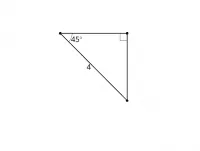
Draw a square and find the intersection of its diagonals. Then, draw perpendiculars from this intersection to the sides of the square, forming two right triangles. Finally, take the average of the hypotenuses of these triangles to represent a 'half-square' length. Ensure the figure is clear and label key points to help understanding.
The prompt above was compiled from the original drawing commands and is for reference only.