
Another Method to Find the Isogonal Conjugate
Loading the math board and drawing, please wait…
In collections
A Tour of Triangle Geometry
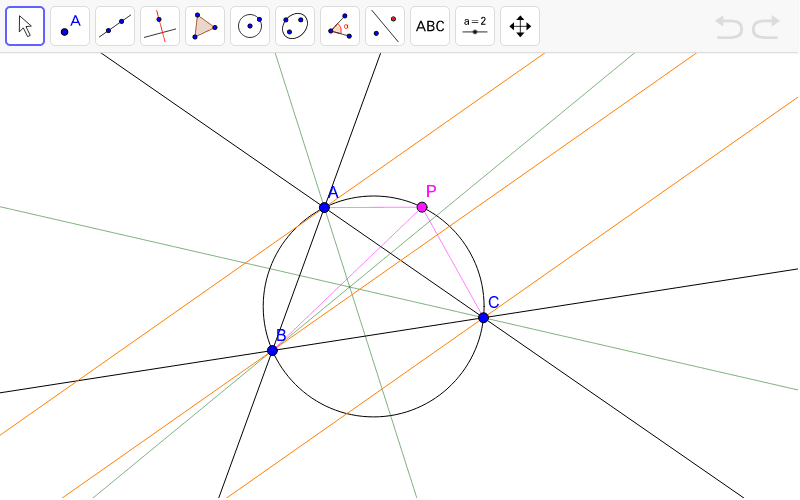
This example demonstrates an alternative method to find the isogonal conjugate of point P by reflecting lines AP, BP, and CP across the angle bisectors of the respective vertices in triangle ABC. Key mathematical concepts include isogonal conjugate, angle bisector, and reflection transformation. The construction utilizes GeoGebra commands and objects such as Line, Circle, Point, Segment, AngularBisector, and Mirror. Suitable for high school and advanced learners to understand the geometric construction and significance of isogonal conjugates.
GeoGebra Commands & Parameters
Line(A, B) → aLine(B, C) → bLine(C, A) → cCircle(A, B, C) → dPoint(d) → PSegment(P, A) → eSegment(P, B) → fSegment(P, C) → gAngularBisector(B, A, C) → hAngularBisector(B, C, A) → iAngularBisector(A, B, C) → jMirror(P, h) → P'Mirror(P, i) → P'_1Mirror(P, j) → P'_2Line(A, P') → kLine(P'_1, C) → lLine(P'_2, B) → m
AI Drawing Prompt Reference
Draw a triangle ABC, then choose a point P inside the triangle. Construct perpendicular lines from P to the sides opposite to vertices A, B, and C, and reflect these lines across the angle bisectors of the respective vertices. This will give you three new points P', P'_1, and P'_2. Finally, connect P' to A, P'_1 to C, and P'_2 to B to find the isogonal conjugate of point P.
The prompt above was compiled from the original drawing commands and is for reference only.