
Animation Demonstrating Right Triangle and Incircle
Loading the math board and drawing, please wait…
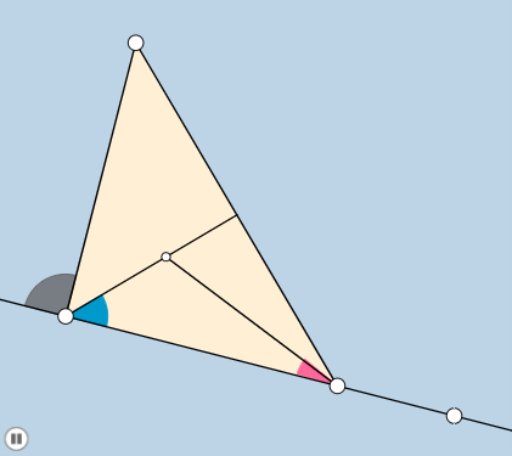
This example dynamically illustrates the properties of an incircle within a right triangle through animation. It covers core concepts like incircles, right triangles, quadratic equations, functions, and geometric transformations. Constructed using commands such as Ray, Point, Segment, Line, Circle, Rotate, and Dilate in GeoGebra, it is suitable for high school mathematics education to explore geometric transformations and their relation to function graphs.
GeoGebra Commands & Parameters
Ray(A, B) → gPoint(g) → FRay(A, F) → hPoint(h) → GSegment(A, G) → kLine(A, B) → aOrthogonalLine(A, a) → dPoint(d) → ERay(A, E) → iPoint(i) → HLine(A, H) → mSegment(A, H) → jCircle(A, Min[(0.15 * j), (0.15 * k)]) → pIntersect(p, m) → O, PIntersect(p, a) → M, NOrthogonalLine(B, a) → ePoint(d) → CRay(A, C) → cRay(A, E) → bIntersect(p, a, 2) → IIntersect(p, i, 1) → JIntersect(p, a, 1) → KPolygon(A, G, H) → poly1, h_1, a_1, g_1CircleSector(A, N, P) → qRotate(q, If[0 < f ≤ 1, (f * π / 2), π / 2], A) → q'Rotate(G, 45°, A) → G'Angle(G, A, G') → αAngle(H, G, A) → βRotate(H, β / 2, G) → H'Angle(H, G, H') → γRay(G, H') → lRay(A, G') → nIntersect(l, n) → DLine(H, G) → rIntersect(r, n) → LIntersect(l, m) → QDilate(A, If[1 < f ≤ 2, 2 - f, 0], L) → A'Segment(A, A') → sIntersect(p, n) → R,Circle(G, (0.15 * Distance[A, G])) → tIntersect(t, r) → S, TIntersect(t, l) → U,CircleSector(G, S, U) → d_1CircleSector(A, R, P) → c_1Dilate(G, If[2 < f ≤ 3, 3 - f, 0], D) → G'_1Segment(G, G'_1) → f_1Rotate(c_1, If[3 < f ≤ 4, ((-(f - 3)) * π / 4), ((-π)) / 4], A) → e_1Rotate(d_1, If[4 < f ≤ 5, ((f - 4) * γ), γ], G) → k_1OrthogonalLine(D, a) → i_1Intersect(a, i_1) → VOrthogonalLine(D, r) → j_1OrthogonalLine(D, m) → l_1Intersect(j_1, r) → WIntersect(l_1, m) → ZAngle(G, V, D) → δDilate(D, If[5 < f ≤ 6, 6 - f, 0], V) → D'Segment(D, D') → m_1Angle(V, D, W) → εAngle(W, D, Z) → ζAngle(Z, D, V) → ηRotate(V, If[6 < f ≤ 7, ((f - 6) * ε), ε], D) → V'CircleArc(D, V, V') → p_1Rotate(W, If[7 < f ≤ 8, ((f - 7) * ζ), ζ], D) → W'CircleArc(D, W, W') → q_1Rotate(Z, If[8 < f ≤ 9, ((f - 8) * π / 2), π / 2], D) → Z'CircleArc(D, Z, Z') → r_1Circle(D, V) → s_1Line(Z, W) → n_1Intersect(l, n_1) → A_1Dilate(Z, If[9 < f ≤ 10, 10 - f, 0], W) → Z'_1Segment(Z, Z'_1) → t_1Dilate(D, If[10 < f ≤ 11, 11 - f, 0], A_1) → D'_1Segment(D, D'_1) → b_1Line(A, f_1) → f_2Point(f_2) → B_1Angle(B_1, A, G) → θDilate(A, If[11 < f ≤ 12, 12 - f, 0], A_1) → A'_1Vector(A, A'_1) → uTranslate(e_1, u) → c_2Rotate(c_2, If[12 < f ≤ 13, ((-(f - 12)) * θ), (-θ)], A_1) → d_2Segment(A, H) → g_2Segment(H, G) → h_2