
Animation Demonstrating Polygons and Geometric Transformations
Loading the math board and drawing, please wait…
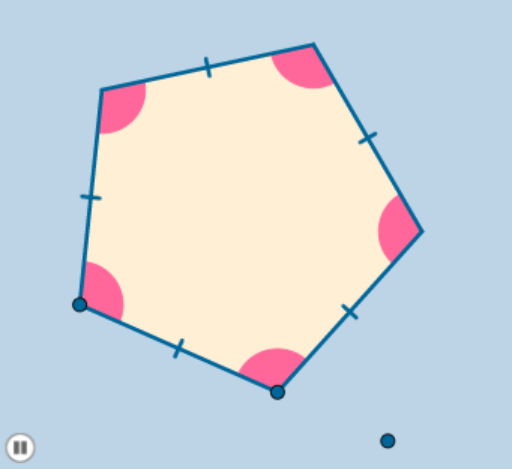
This example demonstrates the rotation, translation, and dilation of polygons and triangles through animation. It involves core mathematical concepts such as polygon construction, vector operations, angle calculations, function graphs, and calculus. GeoGebra commands like Rotate, Ray, Point, Segment, Circle, Intersect, Line, Angle, Min, CircleSector, Dilate, Vector, Translate, Polygon, and OrthogonalLine are used in the construction. Suitable for high school and above students to understand geometric transformations and advanced mathematical applications.
GeoGebra Commands & Parameters
Rotate(A, 108°, B) → A'Ray(B, A') → gRay(B, A) → fPoint(f) → CSegment(C, B) → nCircle(C, n) → d_1Rotate(B, (-(108°)), C) → B'Ray(C, B') → hIntersect(d_1, h, 1) → GCircle(G, n) → e_1Point(h) → DRotate(C, (-(108°)), D) → C'Ray(D, C') → iPoint(i) → ERotate(D, (-(108°)), E) → D'Ray(E, D') → jIntersect(g, j) → FSegment(F, E) → kSegment(E, D) → lLine(G, l) → g_1Intersect(e_1, g_1, 1) → JLine(J, k) → h_1Intersect(h_1, g) → KAngle(A, B, A') → αAngle(B', C, B) → βAngle(C', D, C) → γAngle(D', E, D) → δSegment(D, C) → mSegment(B, F) → pMin(list) → aCircle(B, (0.2 * n)) → qIntersect(q, p) → H,Intersect(q, n) → I,CircleSector(B, I, H) → rDilate(B, If[0 < o ≤ 1, 1 - o, 0], C) → B'_1Vector(B, B'_1) → uTranslate(r, u) → r'Rotate(r', If[1 < o ≤ 2, (((o - 1) * 2) * π / 5), (2 * π / 5)], C) → r''Dilate(C, If[2 < o ≤ 3, 3 - o, 0], G) → C'_1Vector(C, C'_1) → vTranslate(r'', v) → r'''Rotate(r''', If[3 < o ≤ 4, (((o - 3) * 2) * π / 5), (2 * π / 5)], G) → sDilate(G, If[4 < o ≤ 5, 5 - o, 0], J) → D'_1Vector(G, D'_1) → wTranslate(s, w) → s'Rotate(s', If[5 < o ≤ 6, (((o - 5) * 2) * π / 5), (2 * π / 5)], J) → s''Dilate(J, If[6 < o ≤ 7, 7 - o, 0], K) → E'Vector(J, E') → tTranslate(s'', t) → s'''Circle(J, n) → k_1Rotate(s''', If[7 < o ≤ 8, (((o - 7) * 2) * π / 5), (2 * π / 5)], K) → c_1Segment(B, B'_1) → bSegment(C, C'_1) → cSegment(G, D'_1) → dSegment(J, E') → eDilate(K, If[8 < o ≤ 9, 9 - o, 0], B) → K'Segment(K, K') → f_1Polygon(B, C, G, J, K) → poly1, b_1, c_2, g_2, j_1, k_2Rotate(B, If[9 < o ≤ 10, ((-(o - 9)) * α), (-α)], C) → B'_2Rotate(B'_1, If[9 < o ≤ 10, ((-(o - 9)) * α), (-α)], C) → LSegment(B'_2, L) → b'Rotate(B'_2, If[10 < o ≤ 11, ((-(o - 10)) * α), (-α)], G) → MRotate(L, If[10 < o ≤ 11, ((-(o - 10)) * α), (-α)], G) → L'Segment(M, L') → b''Rotate(M, If[11 < o ≤ 12, ((-(o - 11)) * α), (-α)], J) → M'Rotate(L', If[12 < o ≤ 13, ((-(o - 12)) * α), (-α)], J) → L''Segment(M', L'') → b'''Rotate(M', If[12 < o ≤ 13, ((-(o - 12)) * α), (-α)], K) → M''Rotate(L'', If[12 < o ≤ 13, ((-(o - 12)) * α), (-α)], K) → L'''Segment(M'', L''') → i_1Segment(J, B) → l_1Segment(C, J) → m_1Point(b'') → NSegment(K, C) → n_1Segment(N, C) → p_1Segment(N, K) → q_1OrthogonalLine(N, n_1) → r_1Intersect(r_1, n_1) → OOrthogonalLine(B, m_1) → s_1Intersect(s_1, m_1) → PPolygon(B, C, J) → poly2, j_2, b_2, c_3Segment(N, O) → t_1Segment(B, P) → a_1Dilate(B, If[15 < o ≤ 16, 16 - o, 0], J) → B'_3Segment(B, B'_3) → f_2Dilate(C, If[15 < o ≤ 16, 16 - o, 0], J) → C'_2Segment(C, C'_2) → h_2Angle(J, P, B) → εRotate(B, If[16 < o ≤ 17, ((o - 16) * α / 3), α / 3], J) → B'_4Rotate(B'_3, If[16 < o ≤ 17, ((o - 16) * α / 3), α / 3], J) → QSegment(B'_4, Q) → i_2Dilate(B, If[17 < o ≤ 18, 18 - o, 0], P) → B'_5Segment(B, B'_5) → l_2Rotate(B'_4, If[18 < o ≤ 19, ((o - 18) * α / 3), α / 3], C) → RRotate(Q, If[18 < o ≤ 19, ((o - 18) * α / 3), α / 3], C) → Q'Segment(R, Q') → m_2Dilate(K, If[19 < o ≤ 20, 20 - o, 0], N) → K'_1Dilate(C, If[19 < o ≤ 20, 20 - o, 0], N) → C'_3Segment(K, K'_1) → n_2Segment(C, C'_3) → p_2Polygon(K, C, N) → poly3, n_3, k_3, c_4Line(O, l_2) → q_2Circle(O, 5) → d_2Intersect(d_2, q_2, 2) → SAngle(S, O, N) → ζDilate(N, If[20.5 < o ≤ 21.5, 21.5 - o, 0], O) → N'Segment(N, N') → r_2Angle(N, O, K) → ηDilate(B, If[21.5 < o ≤ 22.5, 22.5 - o, 0], O) → B'_6Vector(B, B'_6) → u_1Translate(B, u_1) → B'_7Translate(B'_5, u_1) → TSegment(B'_7, T) → s_2Rotate(B'_7, If[22.5 < o ≤ 23.5, ((o - 22.5) * α / 3), α / 3], O) → URotate(T, If[22.5 < o ≤ 23.5, ((o - 22.5) * α / 3), α / 3], O) → T'Segment(U, T') → t_2
AI Drawing Prompt Reference
Draw a triangle ABC, then rotate it 108 degrees around point B to get A', and draw rays from B to A' and from B to A, finding their intersection point C. Use C as the center and BC as the radius to draw a circle, then rotate B around C to get B', and draw a ray from C to B', finding their intersection point G. Continue this process to construct a series of related shapes, including circles, line segments, angles, and scaling transformations, ultimately forming a dynamic geometric transformation animation.
The prompt above was compiled from the original drawing commands and is for reference only.